





Dear TOVP Leaders and GBC Members,
Please accept our humble obeisances. All glories to Śrīla Prabhupāda. Aniruddha dās here again, with Part 6 of the TOVP Plans. In Part 5, we touched upon the approach of focusing Supporting Shrine efforts on those cosmological locations said to have been visited by Lord Kṛṣṇa. Already, in the Narakān Level Project, we have covered what we believe to be the most famous such cosmic location, the planet of Pitṛloka. However, at least three other such locations remain. We are certain that there will be universal agreement among the devotees that there should be a special Supporting Shrine project at each of those locations in the Vedic Cosmos, and at least one Deity should be installed. We do not believe these plans would be complete without those Supporting Shrines, and hence, we are very pleased to bring you Part 6 of the TOVP Deity Plans: The Nexus of Vedic Cosmology & the Summum Bonum.
A starting note about the four non-Earth locations in the Vedic Cosmos that will be covered here: they are locations from Śrīmad Bhāgavatam. There may be other locations mentioned in other śāstras, but these four from the Bhāgavatam will suffice for now. So without any further ado…
Replacing & Signifying Deities in the Sampradāya History
We are going to have to replace Lord Kṛṣṇa a number of times here, and it therefore seems like an opportune moment to put what we are doing here in perspective, and understand it from the point of view of similar installations carried out by the Past Ācāryas.
It is not necessary to give numerous examples, just a few should suffice. The most important example is the installation carried out by one of the Six Gosvāmīs, His Divine Grace Śrīla Gopāla Bhaṭṭa Gosvāmī Mahārāja, in the Rādhā Raman Temple, one of the most famous and important Vṛndāvana Dhāma Temples. In this Temple, there are two relevant points. The first is that Śrīmatī Rādhārāṇī has been signified and replaced with a crown. Similarly, we shall replace Lords Kṛṣṇa and Balarāma, not only once, but multiple times.
The second point from Rādhā Raman Temple is that Gosvāmī Mahārāja has also installed a footprint of Lord Kṛṣṇa, the Deity Form of which is generally known as “Śrī Caraṇāravinda,” or as “Caran Paduka” specifically at Rādhā Raman Temple. Similarly, we shall be installing Lord Kṛṣṇa’s footprints, but only a part of them.
Lastly, we did already mention in Part 1 of these TOVP Deity Plans how His Divine Grace Oṁ Viṣṇupāda Srīla Bhaktisiddhānta Saraswati Gosvāmī Mahārāja had installed the footprints of Lord Caitanya Mahāprabhu at the Srī Varāha Lakṣmī Narasiṁha Temple. Similarly, we are installing Lord Kṛṣṇa’s footprints, but only parts of them in this particular case, as already mentioned.
We are certain we can agree that this is the minimum of what we want in these Supporting Shrine installations: there should be one Deity installation representing Lord Kṛṣṇa, one installation for anyone who is said to have accompanied Lord Kṛṣṇa, and at least one installation that is connected to that particular location in the Vedic Cosmos. So without further ado, let us begin…
Chapter 1: The Tree of Heaven
The līlā of Lord Kṛṣṇa stealing the Pārijāta Tree from Indraloka appears distinguishable in at least a few ways from the other three locations and līlās mentioned here. Firstly, it is, we believe, one of the best-known of the four. We think Lord Kṛṣṇa’s visit to Pitṛloka may be slightly better-known, but we could be wrong about that. Perhaps this Pārijāta Tree līlā is more well-known. It is a close thing. The Pitṛloka and Indraloka līlās both seem more well-known that the other two.
Secondly, this is the only reported visit to another part of the Vedic Cosmos where Lord Kṛṣṇa was accompanied by one of His Consorts, Śrīmatī Satyabhāmā Devī, one of His 16108 wives from Dwarka. On His other journeys, He is not said to have been accompanied by any women.
Thirdly, this is the only reported journey of Lord Kṛṣṇa to do something besides bringing back the dead, which is what the other three līlās concerned. In this līlā, Lord Kṛṣṇa does of course bring back a living tree instead.
We are certain that the TOVP Executive Committee Members, the GBC Members, and all of the devotees will assess the foregoing points, and universally conclude that there should be a magnificent little Supporting Shrine created to honor Lord Kṛṣṇa’s visit to Indraloka. We are sure everyone will agree this is truly a perfect Minor Supporting Shrine project which should certainly be carried forth.
The only question is about what deities to install. For the Narakān Level Project, we have proposed the installation of the King of the planet in question, Pitṛloka, which is Lord Yamarāja… but the King of Justice is one of the 12 Great Vaiṣṇava Teachers. That is what we considered the justification that opened the possibility of that installation. King Indra, on the other hand, is not one of the 12 Mahājanas. So let us for the moment discard the possibility of installing King Indra.
Śrīmatī Pārijāta Devī
A less obvious possibility is to install a very minor kind of deity, namely of the Pārijāta Tree itself. This kind of installation can perhaps be best thought of as like a priestess installation, or a pūjārī, or servitor of the main Deity. Our installations of the Ācāryas fall into this category of servitors of the Deities, but our Past Ācāryas are considered by us to be more important that something like the Pārijāta Tree. This Pārijāta Tree deity is envisioned to be a slightly smaller deity, and humanoid, and female.
Many of the readers are doubtless wondering, “Are there Pārijāta Tree deities installed as supporting shrine deities in some other temples in India?” According to our research, there are not any such installations, but the trees are apparently sometimes planted within the temple precincts of Kṛṣṇa Temples in particular, somewhat like Śrīmatī Tulasī Devī, but not as much.
Therefore, it appears that this proposed installation of the minor deity of the Pārijāta Tree would be a precedent in Hinduism… which seems difficult to believe. It is, however, objectively speaking, a very minor kind of deity, so maybe there are truly not any installations anywhere. However, we do in fact know that there are other deity installations of objects or beings associated with Lord Kṛṣṇa. Top of the list is the Sudarśana Cakra deity of course, which we have discussed previously, installed as a deity in Śrī Jagannatha Purī Dhāma, and already proposed by us to be installed in the Planetarium Temple. Therefore, the precedent here does not have to do with installing objects associated with Lord Kṛṣṇa. We are not setting a precedent in that regard, but only with respect to the specific object, the Pārijāta Tree.
This seems an opportune moment to mention that the Temple of the Vedic Planetarium will of course factually be the Largest Hindu Temple in the World, and therefore setting a few minor precedents might be not inappropriate. Installing a small Pārijāta deity, we are sure all would agree, is definitely a quite minor precedent, and permissible within the overall Vedic Planetarium Temple Project. The minor deity will be keeping Śrīmatī Satyabhāmā Devī company, and serving her very nicely, we are sure. In the story, itself, in the Bhāgavatam, the Pārijāta Tree was brought down from Indraloka to grace Śrīmatī Satyabhāmā Devīs’s garden. Therefore, setting up the Pārijāta deity as a servitor, priestess kind of role appears to us to be appropriate. As we mentioned earlier, we see the justification as somewhat similar to the installation of Past Ācāryas, who are also of course seen as servitors of the Deities.
Śrīmatī Satyabhāmā Devī
Speaking of Śrīmatī Satyabhāmā Devī, that installation would appear to be completely bona fide under these circumstances. The situation is somewhat like Śrī Śrī Rukmiṇī Dvārakādhīśa, installed by Śrīla Prabhupāda in Los Angeles, but with a different wife. Remember, we have said we want to install anyone who accompanied Lord Kṛṣṇa in each location. So we are sure that all the devotees will find one of Lord Kṛṣṇa’s wives, who accompanied Him on that particular journey, to be an acceptable installation.
The Aṅkuśarāja Deity
Moving forward, the only installation remaining is of course the one that represents Lord Kṛṣṇa. In part 5 of these TOVP Deity Plans, we had said how we should not install Lord Kṛṣṇa more than once in the same temple, and how we must find some deity installation to replace Lord Kṛṣṇa, which we achieved in the Narakānrāja Mandir with the proposed installation of the Sudarśana Cakra. So the Sudarśana Cakra is taken and should not be repeated of course.
As for possible substitutes, it ends up there is a fairly limited list of the most well-known and obvious objects associated with Lord Kṛṣṇa. Those would be the peacock feather, the flute, His footprint, and the individual symbols on the soles of His feet, which are, as described in Śrīmad Bhāgavatam 1.16.33, “the flag, thunderbolt, elephant-driving rod and lotus flower, which are signs of the lotus feet of the Lord.” Out of those, we think many devotees would somewhat favor the symbols on the footprint, considering that the whole reasoning behind these Supporting Shrines is that they commemorate the other planets within the Vedic Cosmos that Lord Kṛṣṇa is said to have visited, and, indeed, stepped upon with His feet.
As it so happens, it looks like there is a quite respectable double-argument for installing the elephant goad as a stand-in for Lord Kṛṣṇa in this particular case of Indraloka. King Indra, in fact, is known for being the possessor of a very famous elephant, which he acquired from the Churning of the Milk Ocean, the elephant Airāvata, who is said to be the King of the Elephants. So that is one part of the argument, showing a solid connection, and giving us enough.
But a further argument is that the elephant goad apparently represents the control of the senses, and King Indra is of course famous for being cursed to be covered in 1000 vaginas, as described in the Skanda Purāṇa, as a result of his lustfully chasing after women. Therefore, the theme of controlling the senses, which the elephant goad represents, would appear to be relevant here as well. We are certain that all the devotees would agree that there is a very solid case here for installing the elephant goad as a stand-in for Lord Kṛṣṇa in this circumstance.
The goad is known as the Aṅkuśa. Perhaps this deity can be named “Aṅkuśarāja,” or “The King of Elephant Goads.” Just as the King of the Elephants, Airāvata, is to be found in Indraloka, so also can be found there the Aṅkuśarāja, The King of Elephant Goads.
A Place of Healing
So that rounds out the proposed installed Deities for the Indraloka Exhibit: Śrīmatī Satyabhāmā Devī, Aṅkuśarāja, and Śrīmatī Pārijāta Devī as a Priestess/ Pūjārī. As a factual matter, the Pārijāta Tree is known for possessing many healing qualities, and is an ingredient in many Ayurvedic cures. So we can perhaps think of Śrīmatī Pārijāta Devī as a kind of Healing Priestess. Maybe pilgrims will come to the Planetarium Temple to get healed! We do not care why they come. Pilgrims may come for many different reasons.
The Cosmic Flower Altar
Moving forward, we did also mention in Part 5 of these TOVP Deity Plans how this exhibit is envisaged to be a Major Art Project, with the Pārijāta tree and flowers as the guiding theme. For those unfamiliar with the tree or flower, it looks like this:
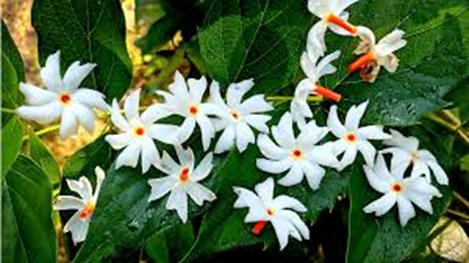
Also known as Night-Blooming Jasmine, the Pārijāta Flower has a distinctive reddish-orangish body and white petals, and is somewhat famous for blooming only at night, with the flowers falling by morning. We have already written in Part 5 how perhaps there could be a large sculpture of the Pārijāta flower, with a bed of smaller Pārijātas, or something similar. All we will add to that here is that some living Pārijāta plants or saplings are also envisioned to be part of the artwork. And of course, the three deities just described should be situated within this artwork. Perhaps we can name this art project, “The Cosmic-Travelling Flower Altar.” Śrīmad Bhāgavatam does indeed relate that the tree was carried through the Vedic Cosmos back to Earth, back to Dwarka. Therefore, describing the tree or flower as a cosmic traveler would appear to have a solid basis in śāstra. That name is, however, perhaps a bit of a mouthful. So perhaps we can make a shorter version, “The Cosmic Flower Alter.”
Now there is an important detail to add in here, which is that this particular artistic exhibit is envisioned to be installed on the actual Cosmic Chandelier, which is another way that this installation is different from the other three. The Deities are not envisaged to be large, in the interests of not overloading the Cosmic Chandelier.
According to the photos put out on the TOVP website, the Cosmic Chandelier will look like this:
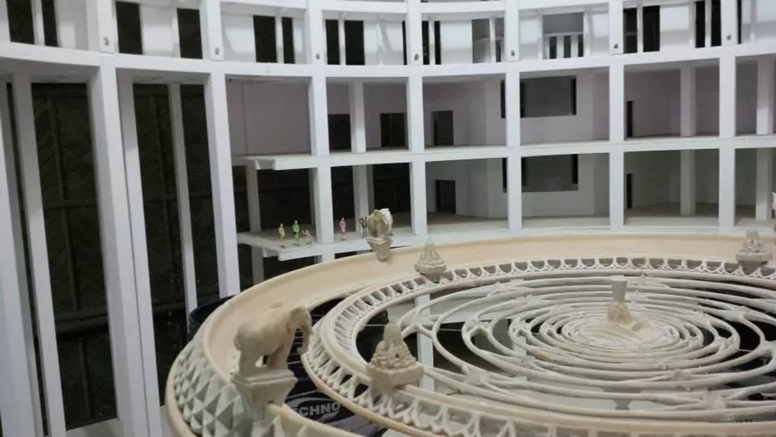
Therefore, what is being proposed is that the Indraloka exhibit just described, including both the Deities and the Cosmic Flower Altar, be placed close to the location of Indraloka within the Cosmic Chandelier. If we look at the picture above, we can see that it all looks to be a marbley-white kind of color. We are certain that all would agree that our proposed Pārijāta-themed Major Art Project will provide a pleasing dash of color to the presentation, with those bright reddish-orangish stalks providing some major artistic contrast! Perhaps on the outer ring, close to one of the balconies, like for example between the two elephants on the far side, with the deities facing the balcony.
So that completes the main proposed installation, although there is in fact a secondary part of the Indraloka Project, not to be placed on the Cosmic Chandelier, but instead on the surrounding balcony (where most exhibits will probably be situated). At that location, as near as possible to the installation on the Cosmic Chandelier, is proposed to be placed not deities, but a diorama of King Indra standing by his throne, arms raised in frustration, as Lord Kṛṣṇa makes off with his prized heavenly tree. A bit of humor is always a winner. We could add more figures to the diorama of course, but that is enough for now. So that is a secondary, but also important part of the vision for this project.
Excellent! That completes the proposed Indraloka Shrine Project. Remember the points that we enumerated at the beginning, how Indraloka is one of the most famous locations said to have been visited by Lord Kṛṣṇa, how it is the only location said to have been visited with one of Lord Kṛṣṇa’s Consorts, and the only location where Lord Kṛṣṇa brought back something other than people thought dead. And we said that this should really be a special project, and was a very suitable location to carry out a Supporting Shrine project, and it should truly be a very high-quality Supporting Shrine project. So that has hopefully been achieved here to the satisfaction of all the devotees.
We believe that we can say from an entirely objective standpoint that this proposal is certainly a highly unusual installation! Very cute, small, a special flower-themed art project. High art! That is what this project is. Also a highly unusual location, on the Cosmic Chandelier itself! Also somehow setting two new minor precedents with the proposed deities, which does seem difficult to believe. Why ISKCON will be leading the entirety of Hinduism with these unprecedented installations! Even though they are only for Minor Supporting Shrines of the Planetarium Temple!
And what will the GBC say when the press or whoever ask them to explain the installation of the Aṅkuśarāja Deity? Of course they will say, “Anyone who sincerely worships the Aṅkuśarāja Deity is sure to become the Master of the Senses, and sure to go home Back to Godhead. Anyone who worships anything to do with Lord Kṛṣṇa is sure to achieve the perfection of life.” What else would the GBC say?
Furthermore, when the artistic conception for the Pārijāta Art piece is finalized, and miniatures are made available for general purchase, we are certain that Śrī Māyāpura Dhāma will experience the hottest selling merchandise it has ever handled, probably selling thousands and thousands of pieces on the very first day! Some special High Art Cosmic Flower Altar for the Planetarium Temple?! Every single ISKCON householder will want a miniature one for their home the minute they come out with miniatures! Sales and fundraising are sure to go through the roof! The TOVP could even sell medium-sized miniatures! And larger-sized miniatures that cost even more! Every single visitor is going to want one!
So… we are certain all the followers of Śrīla Prabhupāda will be very pleased with our proposal here. Remember, this is but a humble Minor Supporting Shrine. But it is at one of the most famous locations that Lord Kṛṣṇa is said to have visited. So it is a very, very special humble Minor Supporting Shrine. This, Prabhus, is the Nexus of Vedic Cosmology and the Summum Bonum!
Now let us move onward to the next cosmological location that is said to have been visited by Lord Kṛṣṇa…
Chapter 2: The Planet of the Demon King
A perhaps somewhat lesser-known līlā of Lord Kṛṣṇa’s, this līlā involved fetching back the slain infant sons of his Mother Devakī, Lord Kṛṣṇa’s brothers, slain by Kaṁsa. We know many of the readers must be immediately wondering, “Should not the slain sons of Devakī be on the planet of Lord Yamarāja? Why would they be on the planet of Mahārāja Bali?”
From the account given in Śrīmad Bhāgavatam, it appears that these six infant sons of Devakī had, in their previous lives, been sons of the Demon King Hiraṇyakaśipu. As to what those sons of Hiraṇyakaśipu could have possibly done to be reborn as the infant sons of Devakī, only to be immediately destroyed by Kaṁsa… perhaps it is best if we simply give the Bhāgavatam verses, where Lord Kṛṣṇa Himself explains the matter thusly to the King of the Demons:
“During the age of the first Manu, the sage Marīci had six sons by his wife Ūrnā. They were all exalted demigods, but once they laughed at Lord Brahmā when they saw him preparing to have sex with his own daughter.
“Because of that improper act, they immediately entered a demoniac form of life, and thus they took birth as sons of Hiraṇyakaśipu. The goddess Yoga-māyā then took them away from Hiraṇyakaśipu, and they were born again from Devakī’s womb. After this, O King, Kaṁsa murdered them. Devakī still laments for them, thinking of them as her sons. These same sons of Marīci are now living here with you.” (Śrīmad Bhāgavatam, 10.85.47-49)
That is the explanation for why the slain sons were in Sutala instead of with the God of Death. We also note that Lord Kṛṣṇa was accompanied by Lord Balarāma on this journey.
The Vajranātha Deity
Let us start with Lord Kṛṣṇa this time, and of His various remaining foot markings, there are the lotus, the lightning bolt, and the flag. Out of those, we are certain many devotees will immediately zero in on the lightning bolt, since the lighting bolt is connected to King Indra, who was vanquished by Mahārāja Bali, as related in Śrīmad Bhāgavatam. In fact, Mahārāja Bali is factually referred to in that way in the Śrīmad Bhāgavatam account, as “Bali, the conqueror of Indra’s army” (10.85.38). So this appears reasonable enough. The lightning bolt is known as “Vajra.” So perhaps we can name the deity “Vajranātha,” or “The Lord of the Thunderbolt.”
The Gadāyuddhaji Deity
Moving forward, we must now find a first replacement for Lord Balarāma, since there is already a regular Balarāma Deity proposed to be installed in the Narakānraja Major Supporting Shrine. Lord Balarāma does not appear to have quite as many particular objects associated with Him as Lord Kṛṣṇa does. The most famous such object is surely the giant plow, and of course He was also known for being a Master of the Mace. In fact, a connection to the mace can be immediately found, since , the King of the Planet in question, Mahārāja Bali, is generally depicted as being armed with a mace. “Master of the Mace,” in Sanskrit, is Gadā-yuddha. So the proposed name of the Mace Deity will be Gadāyuddhaji.
The Demon King
That just leaves the one required installation from the Realm itself, from the Planet Sutala. Of course, an obvious first possibility is Bali Mahārāja himself, the Lord of the Realm, and one of the 12 Mahājanas as well. Those identical characteristics were part of justifying the installation of King Yamarāja in the Narakān Level Project. However, we know the readers must all be wondering if there are any instructions in the Viṣṇu-dharmottara about installing Mahārāja Bali, like there were for installing the King of Justice. Considering that Mahārāja Bali is considered the Greatest King of the Demons, and Hindus are not in the practice of installing many Demon King deities, it may not be very surprising to many of our readers that the Viṣṇu-dharmottara has nothing about installing Mahārāja Bali, no accompanying deities, no how he should look, no nothing.
And since all the devotees are very intelligent, they next ask questions like, “Well, surely there must be a small temple somewhere or other in India for Mahārāja Bali.” But it does not appear that there is actually, although there might still be one somewhere. We do not believe Hindus build many temples to Demon Kings.
And since the devotees are so intelligent, they next ask questions like, “Well surely there are at least some supporting shrines around of Mahārāja Bali, just small supporting shrines, since he is, after all, one of the 12 Mahājanas.” Well one would think so! Surely! But no, no, there do not appear to be any small supporting shrines with Mahārāja Bali. Of course, the devotees must realize that getting accurate information about small supporting shrine deities at thousands or millions of small or medium-sized Hindu Temples is actually not possible at this time, as the information is simply not available. So we must simply put it this way, we have factually not managed to identify or locate a Supporting Shrine of Mahārāja Bali.
But surely Vāmanadeva Temples must have supporting shrines with Mahārāja Bali! If we look at what is generally considered the most famous and important Vāmanadeva Temple in all of India, the Thrikkakara Vamanamurthi Temple in Kerala, said to have been established by none other than Lord Paraśurāma, we find that the Minor Supporting Shrines house deities of Gopālakṛṣṇa, Nāga, Bhagavati, Sasthavu, Brahmarākṣasa, and Yakshi. Those are not Mahārāja Bali, and it seems difficult to comprehend how there could be a minor deity of a Brahmarākṣasa, but no deity of Mahārāja Bali. It seems peculiar, does it not?
But then it ends up the Vamanamurthi Temple does also have an external Major Supporting Shrine on the temple property, a Śiva Temple, housing deities of Lords Śiva, Gaṇeśa, Kārtikeya and Durgā. Yes, but those are not Mahārāja Bali either.
Strangely, upon further digging, we have in fact discovered that there was apparently an effort to install a “statue” of Mahārāja Bali at this particular temple, several years ago in 2017, but that the effort was apparently blocked by some Hindu group, the Aikya Vedi, they are called… believe it or not.
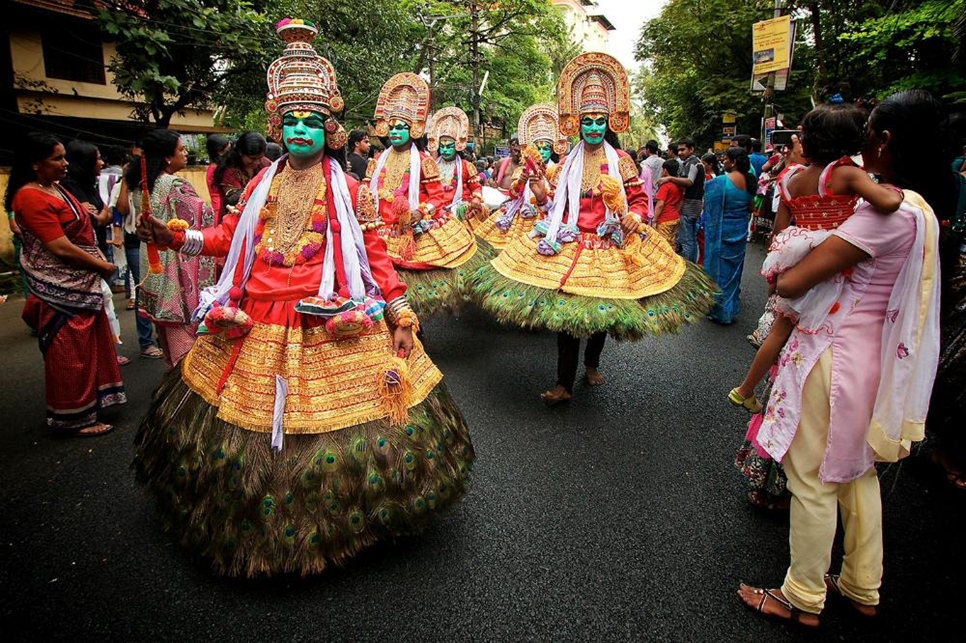
One important point is that Vamanamurthi Temple has a massive festival every year, the Onam Festival, a 10-day festival, the largest festival of the year in the entire State of Kerala. And this festival celebrates the return of Mahārāja Bali every year. According to the local legend, Mahārāja Bali was sent off to rule Sutalaloka, but part of the deal was that he would return one day every year. So there are many, many dancers that look somewhat like King Bali:
There are even some newspaper articles about the matter, and we frankly thought the temple management had the better of the debate. They were saying things like:
“Defending the plan, Prayar Gopālaakrishnan, president, TDB, which manages the shrine, said though Mahabali was an ‘asura’ ruler, he was a hardcore devotee of Lord Vishnu and there was nothing wrong in installing his statue on the temple premises.
“’ The TDB plans to organize an in-depth presentation of the mythical story and the characters of Mahabali and Vamana at the temple during the Onam days. We hope it will clear doubts and misconceptions of devotees over the issue,’ he said.”
Meanwhile, the objectors were saying that this was the only temple in Kerala dedicated to Lord Vamana, and so they did not want Mahārāja Bali on the premises. There is a link to the article right here.
We personally found it strange that there was no Mahābali deity installed already, especially considering that there is this whole huge Onam festival every year based on his fabled return. And Mahārāja Bali is the most important other participant in the Vāmanadeva līlā, which most readers doubtless know for themselves. And it sounded like the objectors were saying that Mahārāja Bali would contaminate the temple? And it should just be a pure Vāmanadeva Temple? But then there are already all these other Supporting Shrines, to a Brahmarākṣasa, and a Yakshi, and to Lord Śiva, and Goddess Durgā. So somehow it is only Mahārāja Bali that will somehow ruin the temple or make it impure? It seemed pretty strange to us.
Actually, we suspect that the temple originally had a Bali deity. It just seems very peculiar to us that there would be installed deities of a Brahmarākṣasa, and to Lord Śiva, and Goddess Durgā, but not of Mahārāja Bali. Since Mahārāja Bali is known as being the King of the Demons, maybe the British or Muslims got rid of the deity, or some other calamity occurred, maybe farther back in history.
At any rate, we can say this about the most important Vāmanadeva Temple in India: they have been trying to put a Bali Mahārāja “statue” in, which is not even a fully installed deity… but it has not been going so well apparently.
However, surprisingly perhaps, if we look at what is probably the second most well-known Vāmanadeva Temple in India, the Ulagalantha Perumal Temple in Tirukkoyilur, they do appear to have a Mahārāja Bali deity installed, and right on the main altar as well, along with deities of Mahālakṣmī, Prahlāda, Śukrācārya, Sage Mṛkaṇḍu and three Mudhal Alvars (poet/saints). So this looks like Mahārāja Bali in factually installed in at least one very important temple, and ISKCON would not be setting a precedent in that regard. Both of these temples we have been looking at are included in the 108 Divya Deśam Temples, Ancient Temples specially dedicated to Lord Viṣṇu.
So our possible plan here does not even involve Mahārāja Bali being installed on the Main Altar, like in the Ulagalantha Perumal Temple – our plan is only for a humble Supporting Shrine. But still we suppose there might be some Hindus or devotees who insist, “We do not worship Demons! Or Demon Kings!”
However, ironclad evidence does not support the assertion that we do not worship Demons or Demon Kings. Factually, in ISKCON’s International Headquarters, in Śrī Māyāpura Dhāma, thousands of devotees worship a Demon every day, a Demon King in fact. A small Demon King, it is true, but a member of the Demon King line all the same. We speak of course of Prahlāda Mahārāja, the grandfather of Mahārāja Bali. And Prahlāda Mahārāja is proposed to be one of the central deities of the entire Planetarium Temple, whichever deity plan one looks at. All that we are talking about here with Mahārāja Bali is a humble Supporting Shrine. So we think all would agree that this possible installation of Mahārāja Bali is looking more and more possible.
Situating the Demon Planet Shrine
Moving forward, there is the matter of where to place this Sutalaloka Supporting Shrine, and it looks like there are at least four respectable possibilities. We could place it on the Cosmic Chandelier, but this Shrine is not envisioned as a particular, special work of art, like the Cosmic Flower Alter for Indraloka. So let us discard that possibility.
Another possibility is some lower level room of the Planetarium Level, since this is a lower planet. But we do already have a planned lower-level shrine, the one “Major” Supporting Shrine, Narakānrāja Mandir. Then a room on the Pūjārī Level perhaps? Seems a peculiar shrine for the Pūjārī Level though, with it being a Demon Planet.
A third possibly more interesting possibility is the Kūrma Temple, under one of the main Side Domes. Mahārāja Bali was, as most readers doubtless know, one of the key players in the Churning of the Ocean of Milk. Therefore, this would look very legitimate as a small Supporting Shrine along the edge of the temple room, joining Lord Kūrma of course, and also His Divine Grace Śrīla Viṣṇupāda Bhaktisiddhānta Gosvāmī Mahārāja. Looks like it would be a very unusual combination of deities. There is, however, one insignificant problem with that plan, which is that Lord Kṛṣṇa did not visit Mahārāja Bali at the Ocean of Milk, which is said to be located on another planet, and not on Sutalaloka.
The Lamps of Chuttuvilakku
There is one further element we can add in which may help us place the Shrine, which is Chuttuvilakku Lamps, which are a special tradition at the Trikkakara Vamanamurthi Temple, celebrated during the famous Onam Festival, which we have just now been discussing. For the lamp part, thousands of these Chuttuvilakku Lamps, small lamps made of brass and filled with coconut oil, are lit. Part of the display looks like this:
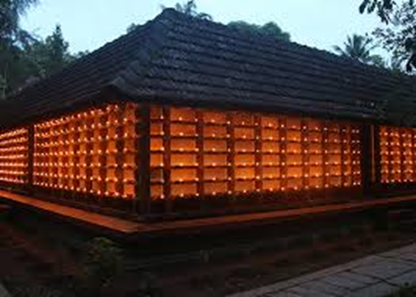
Our proposal with respect to these special lamps is to add them as an important additional element of this Supporting Shrine. We shall have to see if we do thousands of lamps. For now, let us say 108 lamps, but they are envisioned to always be burning within this special shrine. The lamps should help with creating a very unique mood, and make for a lovely Demon Planet Shrine, which will probably end up being quite contemplative, or meditative as a result of the lamps, unusual qualities perhaps to associate with a Demon Planet.
That additional element should also help with placing the Shrine, since we would probably want a location with superior ventilation, what with so many lamps burning all the time. Therefore, what would probably be best is one of the Catri Towers, most likely the South Catri Tower. The Catri Towers seem very ideal locations for Supporting Shrines, we are certain all the devotees will agree. So the South Catri Tower can be the planned location for now.
The Omen
So we are all set here with our Sutalaloka plan, but there is unfortunately just one further insignificant difficulty. People might say we are asking too much of the GBC to approve these plans, what with the Demon Kings as such which have been included. Would it not be horrible if this single installation derailed the entire enterprise?
It does seem to us that there was a bit of an omen with what we discovered about the Trikkakara Vamanamurthi Temple, with the temple management trying to add simply a statue, not even a fully installed deity, but ending up running into resistance, and the project being halted for that reason. We certainly would not want our project here to be similarly halted for similar reasons.
So we want the TOVP Committee Members, The GBC Members, and all the devotees to be a witness to how restrained we are being with our proposals to ISKCON here: we are going to remove our proposal to install Mahārāja Bali. Devotees will truthfully be able to say, “The proposals were cut back to make them easier for the GBC to approve. They were toned-down proposals. They were restrained proposals. The Demon King was taken out.”
The Mālāmamlānapuṣpām Deity
But if we do not install Mahārāja Bali, who or what can be the installation for the realm of Sutalaloka? It ends up that there is at least one further possibility, which we hope will sail through the GBC without any problem. We can install the Eternal-Blooming Garland which Prahlāda Mahārāja put around the neck of Mahārāja Bali as he was about to march forth to conquer Indraloka, as related in Śrīmad Bhāgavatam 8.15.6: “Prahlāda Mahārāja offered Bali a garland of flowers that would never fade.”
In the word-for-word to Śrīmad Bhāgavatam 8.15.6, the Sanskrit is given as mālām-amlāna-puṣpām — or “the garland made of flowers that do not fade away.” Therefore, the name that will be proposed for this flower garland deity is the same, Mālāmamlānapuṣpām, just like the original Sanskrit. An extra-long name for a super-humble servitor deity.
If the GBC are asked by the press and such to explain this installation, the GBC can reply thusly: “It is of course only a Minor Supporting Shrine deity, and a humble servitor deity. But since you ask, if anyone prays to the Mālāmamlānapuṣpām deity, they will be blessed to achieve victory in battle, just as Bali Mahārāja was blessed when wearing the garland… unless the people praying are too stupid, in which case they will lose in battle, no matter how much they pray.”
Actually, the part about any worship of demons bringing victory is mentioned in none other than Śrīmad Bhāgavatam itself, in Śrīmad Bhāgavatam 2.3.9, wherein it is stated: “the demons are sought for defeating enemies.”
Of course, it is a flower garland, and not a demon. But it is the flower garland of the Demon Kings, so there does seem to be a certain legitimacy to calling it the “Demon Garland.” It is a Demon Planet after all, even if it is said to be ruled by a very enlightened Demon King.
At any rate, we are certain it will be a popular shrine for the Kṣatriyas when they come to compete in the Tournaments. They can pray to strike as swiftly as a thunderbolt! And as strongly as Lord Balarāma’s mace! And to look as great as Mahārāja Bali did when was heading off to conquer Indraloka with his Undying Garland on!
Also, again, this particular installation of the Undying Garland is envisioned of as like a priestess or servitor deity, just like the Pārijāta Tree deity, and it would be serving the Deities of Lords Kṛṣṇa and Balarāma, just like Bali Mahārāja served their Lordships when they came to visit Sutalaloka. We have replaced Lords Kṛṣṇa and Balarāma of course, because we have a special project here and they are already planned to be installed elsewhere, and it is necessary to replace Them. But if we had not replaced Them, the Mālāmamlānapuṣpām deity would of course be serving Kṛṣṇa-Balarāma Deities.
And we can add in that the GBC or TOVP Committee Members can of course speak up and put forth the idea if they think the Bali Mahārāja installation is something we should go back to and that they want to support. All it takes is putting out a short statement like this:
“We already have Prahlāda Mahārāja, another Demon King, installed in Māyāpura Dhāma, and Bali Mahārāja is factually said to be the Lord of one of the Realms that Lord Kṛṣṇa is said to have visited, and also one of the 12 Mahājanas, and is also installed as one of the Main Deities in Ulagalantha Perumal Temple, a Member of the 108 Divya Deśam Temples. Lord Viṣṇu even served as his doorkeeper! That is enough for me, I am giving this project a green light. This is only a small Supporting Shrine project, not a Main Temple.”
That is all one of the GBC Members needs to say, or one of the TOVP Leadership, and we can get Bali Mahārāja back into the plans. Or we could even possibly install both the Undying Garland and Bali Mahārāja. But for the moment, let us put those matters to the side, unless one of the GBC Members or TOVP Leadership speaks up about them. For the moment, our proposed single deity installation representing the realm of Sutalaloka will be the Undying Flower Garland, the Mālāmamlānapuṣpām servitor deity.
Finally then, we have our Deity Plans for Sutalaloka, the Realm of the Demon King: There will be a Deity of the Lightning Bolt on Lord Kṛṣṇa’s footprint, known as the Vajranātha Deity; and then the Master of the Mace, Lord Balarāma, which would be a mace deity, Gadāyuddhaji; and then lastly, for the moment, the Mālāmamlānapuṣpām Undying Garland, servitor deity.
The first thing that we are certain most devotees will appreciate about our final proposal here is that it is very unusual. We think many devotees may do something similar as with the Cosmic Flower Altar, and pick up a miniature version of this Supporting Shrine for their own home. It has even managed to end up being kind of esoteric and meditative. The Lightning Bolt Deity! The Mace Deity! And the Undying Flower Garland servitor deity. Here, Prabhus, is the Nexus of Vedic Cosmology and the Summum Bonum.
And we now move forward to the final non-Earth location identified in Śrīmad Bhāgavatam as one of those to have been visited by Lord Kṛṣṇa…
Chapter 3: Outside the Universe
The final location to be covered here is the Kāraṇārṇava Ocean, the abode of Mahā Viṣṇu, where Lord Kṛṣṇa is said to have taken Arjuna to retrieve the son of a brāhmaṇa, as related in Śrīmad Bhāgavatam 10.89.
Śrīpād Arjunaji
Regarding the installed deities, we can start with Śrī Arjunaji, who, to our knowledge, is not thus far planned to be installed anywhere else in the Temple of the Vedic Planetarium. He is, however, apparently installed at a few ISKCON Temples already, namely ISKCON Kurukshetra and ISKCON Aligarh. Presumably, getting clearance from the GBC on this particular installation should be a breeze. So the big news is that it looks like Śrīpād Arjunaji will be joining the Temple of the Vedic Planetarium! We are certain that the TOVP Executive Committee Members, GBC Members, and all the devotees will be overjoyed!
And we are not even going to have to replace Arjunaji! We can simply have a regular deity! It is practically unbelievable!
The Dhvajarāja Deity
Moving onto how to represent Lord Kṛṣṇa, it is now between the lotus and the flag. Considering that Mahā Viṣṇu is considered to truly be outside of our current universe, it seems like there is some kind of argument for the flag. But we can use elimination as well. The lotus is somewhat overused already, with it being ISKCON’s official logo. Therefore, we are sure the devotees will agree that the flag is reasonable enough, a very nice flag, of course. That will be a separate artistic project of its own, as will all of the deities mentioned heretofore. The flag mark is known as “Dhvaja,” so the deity can be called “Dhvajarāja,” or “The King of Flags.”
The Consort Potencies
That just leaves some installation from the Realm, from the Kāraṇārṇava Ocean. The account in Śrīmad Bhāgavatam 10.89.56 describes the others present as follows:
“Serving that topmost of all Lords were His personal attendants, headed by Sunanda and Nanda; His cakra and other weapons in their personified forms; His consort potencies Puṣṭi, Śrī, Kīrti and Ajā; and all His various mystic powers.”
Out of those, we thought the Consort Potencies looked the most promising. Are not Consort Potencies always the most promising? So that would mean the installation of four Deities, the Consort Potencies of Mahā Viṣṇu, Śrīmatī Puṣṭi Devī, Śrīmatī Śrī Devī, Śrīmatī Kīrti Devī, and Śrīmatī Ajā Devī. Śrīla Prabhupāda has explained the significance of these Consort Potencies in Chapter 88 of Kṛṣṇa Book:
“The Lord has innumerable energies, and they were also standing there personified. The most important among them were as follows: Puṣṭi, the energy for nourishment; Śrī, the energy of beauty; Kīrti, the energy of reputation; and Ajā, the energy of material creation.”
The devotees will also doubtless notice Śrīla Prabhupāda’s use of the phrase “most important,” which looks to be another reason for choosing the Consort Potencies to install over the other possibilities.
For location, it seems reasonable enough to propose one of the balconies, which is where most of the exhibits will probably go. One of the highest balconies would probably be appropriate, and it could be a large or small balcony, either way.
That now gives us our basic deity installation plan, which includes a regular deity of Śrīpād Arjunaji, and then also the Flag form of the Dhvajarāja Deity, and the Four Consort Potencies: Śrīmatī Puṣṭi Devī, Śrīmatī Śrī Devī, Śrīmatī Kīrti Devī, and Śrīmatī Ajā Devī. We are certain that all the devotees will agree that this Minor Supporting Shrine is looking in very solid shape.
Furthermore, this Shrine Project, unlike the others, has a few important options that the TOVP Executive Committee Members and the GBC should certainly know about. The first is the possibility of…
A Second “Major” Supporting Shrine
We do of course already have the Narakānrāja “Major” Supporting Shrine in the plans, with seven planned Deities to be installed, and the Four Doors, and the Kṣatriya Academy attached to it as well. There is a similar possibility of expanding this Kāraṇārṇava Ocean plan with more deities. Of the personalities mentioned in the Bhāgavatam verse earlier, some obvious further additions are Mahā Viṣṇu’s leading personal attendants, Sunanda and Nanda. Additionally, it is mentioned in an earlier verse that Lord Kṛṣṇa is said to have journeyed to this particular location in His chariot, and with his four horses:
“In that darkness the chariot’s horses—Śaibya, Sugrīva, Meghapuṣpa and Balāhaka—lost their way. Seeing them in this condition, O best of the Bhāratas, Lord Kṛṣṇa, the supreme master of all masters of yoga, sent His Sudarśana disc before the chariot. That disc shone like thousands of suns.” (Śrīmad Bhāgavatam 10.89.48-49)
So we could also install the four horses, since we had said earlier that we want to install anyone who is said to have accompanied Lord Kṛṣṇa on any of these cosmic journeys. And the horses would seem to qualify under that category. So the personal servants and the horses would bring the total number of installed Deities up to 12, and we would consider it a Second “Major” Supporting Shrine.
We are not going to include those deities in our formal proposal at this time. We will just go for now with the Minor Supporting Shrine plan. But if any of the TOVP Committee Members or GBC Members favor a larger shrine for this particular project, with the additional deities of the servants and/or the horses, then they should speak up about it and say so.
This particular cosmological location also has the further option of…
Replacing Mahā Viṣṇu!
We know we are not going to install a Mahā Viṣṇu Deity. But we have been doing so much replacing of deities in this current set of plans that the idea perhaps naturally presents itself of possibly installing a replacement for Mahā Viṣṇu. Out of the possibilities, the one that seemed most promising to us was Lord Viṣṇu’s flower garland, which is known for being very long down to the knees, and is named “Vaijayantī.” So we could install a “Vaijayantīji” Deity.
It is perhaps worth noting that performing special rituals involving the Vaijayantī Garland is apparently somewhat of a tradition in Kanchi and Tirupati. Possibly, such garlands are installed, but it is difficult to be sure. The garland must surely be installed somewhere.
With respect to the material, the garland could be made of super-hard glass, or perhaps of metal, and then painted. According to the Viṣṇu Purāṇa, the garland is made of diamonds, rubies, emeralds, pearls, and yellow sapphires. We are not going to include the garland in our current proposal, but it looks easy enough to add on if the TOVP Committee Members or GBC Members favor the addition. And that completes our plan for the final Cosmic Location said to have been visited by Lord Kṛṣṇa.
Tour de Force Works of High Art!
Please note that we know there are some other lists of what the symbols are on Lord Kṛṣṇa’s feet. We just went with the short list from the Bhāgavatam here, and that will suffice for now, until we see if the GBC will approve these plans.
Also, we know there may be some other Cosmic Locations mentioned in other Purāṇas as having been visited by Lord Kṛṣṇa. Similarly to the last point, we think seeing if the GBC will approve these four from the Bhāgavatam is the way to go currently.
Also, as far as original artworks that are proposed to be created, we were perhaps understandably quite focused on the Cosmic Flower Altar, but every single deity mentioned should, as far as we are concerned, be a tour de force work of High Art, especially all of the non-anthropomorphic deities, such as the Elephant Goad Deity, Lord Balarāma’s Mace, the Lightning Bolt Deity, the Undying Garland of Bali Mahārāja, the Flag Deity, and the Garland of Mahā Viṣṇu.
As to how such masterpiece artistic creations shall be manifested into reality, we, your worthless dog-like servant, Aniruddha dās, are of course here at your service. Never fear! We shall fetch forth for you these artistic masterpieces! Do not worry about a single thing!
But we would of course need a “Formal Commission” from the TOVP Executive Committee, or from the GBC of course, or a Joint Commission from both bodies, tasking our worthless self with producing these 8th Wonders of the World. Of course, we would bring the artistic conceptions to the TOVP Committee or GBC to get final approval.
There would be quite a number of these special artistic projects, starting with the Cosmic Flower Altar, and then also the Swan Altar, and the Goloka Vṛndāvana Orb, and the Four Doors, and the two four-eyed hounds for the Narakān Level project, which is five major art projects. And then all the new deities which have been proposed by us, including Lords Varāha, Kūrma, and Hayagrīva, and then also Śrīmatī Bhumi Devī, and also Śrīpād Nārada Muni, plus the seven deities in the Narakān Level, and then all the deities that we have described here for the Supporting Shrines. So that totals out to 24 deities, all of which we want to look really great of course. We expect each one to be an artistic masterpiece. So we can see it is quite a lot to get done.
But do not worry! As we said, all it takes is a simple commission, tasking us with creating all the various works of art and deities, and we, your worthless servant, shall get it done. We believe the formal title would be “TOVP Special Art Projects Director.”
Precedents
Turning now to any precedent-setting, there is a fair amount that seems like it is maybe not precedent-setting, like installing Mahā Viṣṇu’s garland… but it could be. The most important thing though, it appears to us, is whether we are on-point. If we are on-point, and our methods and results appear to be coming together nicely, then some minor precedents are probably acceptable. Also, as a factual matter, the Planetarium Temple will be the Largest Hindu Temple on Earth, which surely opens the door to some minor precedents, if not major ones.
An important point to note about such precedents is that they came out of some very simple research activities, which we are certain that all the devotees will approve of. The first is digging a little into our tradition, like with the Rādhā Raman Temple, and Śrīmatī Rādhārāṇī having been replaced with a crown. Also, from that same temple was the installation of Lord Kṛṣṇa’s footprint, which we also drew on.
And the second kind of activity was digging a bit more into Kṛṣṇa Līlā, pinpointing the non-Earth locations in the Vedic Cosmos He is said to have visited, and then checking up on the signs on Lord Kṛṣṇa’s feet and that sort of thing.
So those two activities are the only things that have been going on with producing these Deity Plans, and any minor precedents that may be present. And also the fact that the temple is very large, so we are working on multiple Supporting Shrine projects which are related to each other, and not wanting to repeat any deities. We are certain that all of the devotees will agree that the foregoing explains all that has been going on here, the entire process is very transparent and verifiable by anyone who can read, and that under these circumstances, such minor precedents are acceptable, and possibly even desirable in such a large and important Temple.
We also believe, obviously, that there will be strong support by all devotees for our method, which is very transparent, as we said, of planning one installation for Lord Kṛṣṇa in each location, the installation of whoever is said to have been with Lord Kṛṣṇa, and also at least one installation from the Realm in question. And we are certain the devotees will be pleased with the results as well. Some very, very unusual shrines, to be sure, but very legitimate and bona fide as well. We are certain that the Minor Shrines especially will be big hits with the devotees, and many of them will buy miniature versions for their own homes.
We should also note that with respect to the groupings of the deities, those precedents probably are indeed real precedents. Like does anyone think there is a temple somewhere in India that has the elephant goad form of the Lord, Śrīmatī Satyabhāmā Devī, and a human deity form of the Pārijāta Tree? Probably not. So the grouping of the deities are likely a precedent. But we do not know of any other temple focused on the theme of Vedic Cosmology. Therefore, setting some precedents with the deity groupings appears legitimate. And one thing is for sure, the deity groupings are based on the accounts given in Śrīmad Bhāgavatam, which means that the groupings are definitely bona fide.
The Cosmic Kṛṣṇa Shrines
This concludes the proposed Supporting Shrines based upon the four locations in the Vedic Cosmos said to have been visited by Lord Kṛṣṇa in Śrīmad Bhāgavatam. Possibly the most famous, the Planet of Pitṛloka, has been addressed by us previously, in Part 4 of these Deity Plans, with installations of Lord Yamarāja, Lord Balarāma, the Sudarśana Cakra, and more.
Here, we have added Supporting Shrine Projects for the other three cosmological locations described in Śrīmad Bhāgavatam. Starting us off, Indraloka, with installations of Aṅkuśarāja, the King of Elephant Goads; Śrīmatī Satyabhāmā Devī, Lord Kṛṣṇa’s Wife; and Śrīmatī Pārijāta Devī, the personification of the Tree of Heaven, whom we are sure will serve their Lordships very, very nicely. On top of that, this Supporting Shrine includes a very special altar, a tour de force original work of High Art, the Cosmic Flower Altar, based upon the Pārijāta Flower. And last but not least, the most highly unusual location within the Planetarium Temple, mounted upon the body of the Cosmic Chandelier itself! We are certain that all of the TOVP Committee Members, GBC Members, and devotees in general will be very, very, very pleased with the conception and vision on this project, pleased with the method and its results, pleased with everything. We predict this one will be the crowd favorite out of all our Supporting Shrine Projects.
We also have here a proposal for a Supporting Shrine based upon Lord Kṛṣṇa’s reported visit to the Planet of the Demon King, which includes an installation of the thunderbolt upon Lord Kṛṣṇa’s foot, the Vajranātha Deity; and an installation of Lord Balarāma’s Mace, the Gadāyuddhaji Deity; and an installation of the Undying Flower Garland given to Bali Mahārāja by Prahlāda Mahārāja, the Mālāmamlānapuṣpām servitor deity, whom we are sure shall serve the other two deities very, very nicely. This shrine unbelievably turned out quite esoteric, it seems, since this is the only shrine where we ended up with all replacements, and no anthropomorphic deities. Also, the Kṣatriyas will doubtless appreciate this Shrine (remembering that there is a planned Ksatriya Academy). Excellent Shrine to pray at before Tournaments! Also, notably, due to the addition of the Chuttuvilakku Lamps, we appear to have a Demon World Shrine that may actually be contemplative and meditative! For all the above reasons, we think this one will be very popular in miniature versions that many devotees will want as Minor Supporting Shrines for their own homes, and also very popular with visitors to Māyāpura Dhāma. The key point with this one is maybe to always remember that it is a Kṛṣṇa Temple, even if a very unusual one. Each of these Supporting Shrines we have been working on is an unusual, or very unusual, kind of Kṛṣṇa Temple, or, in the context of the Planetarium Temple, a kind of Cosmic Kṛṣṇa Shrine.
Last but not least, we have a proposal and plan for a Kāraṇārṇava Shrine, outside of this Universe. And welcoming Śrīpād Arjunaji to the Temple of the Vedic Planetarium, which we are certain all the devotees will be very, very pleased about. Additionally, we have proposed a deity of the flag mark on Lord Kṛṣṇa’s feet, the Dhvajarāja Deity. And also the installation of the four Consort Potencies of Mahā Viṣṇu, namely Śrīmatī Puṣṭi Devī, Śrīmatī Śrī Devī, Śrīmatī Kīrti Devī, and Śrīmatī Ajā Devī, whom we are certain will receive a very, very warm welcome from all the devotees. Also, we have some nice options with this Shrine, and the possibility of upgrading it to a “Major” Supporting Shrine, with more deities, including Mahā Viṣṇu’s Personal Servants, Lord Kṛṣṇa’s four horses, and possibly Mahā Viṣṇu’s garland, the Vaijayantīji Deity. We are certain the devotees will be pleased with the way this Supporting Shrine shaped up. It may not be quite as artistic as the Indraloka Shrine, or quite as esoteric as the Sutalaloka Shrine, but we are certain many devotees will pick up miniatures of this shrine for their home altars as well. And we are certain that devotees will relish visiting this shrine and all the others in person.
Regarding names of the shrines, there are a few ways to go. One is that the Shrines could be named based on the name of the planet, which would give us Indraloka Mandir, Sutalaloka Mandir, and Kāraṇārṇava Mandir. The other option is to name the Shrines after the name of the Kṛṣṇa deity, from the symbols on His feet. So that would give us Aṅkuśarāja Mandir for the elephant goad, Vajranātha Mandir for the lightning bolt, and Dhvajarāja Mandir for the flag. Lastly, we could use both names, giving us Indraloka-Aṅkuśarāja Mandir, Sutalaloka-Vajranātha Mandir, and Kāraṇārṇava-Dhvajarāja Mandir. We are thinking to propose the last possibility. Small shrines with extra-long names! Makes perfect sense! But they are very important small shrines. So it does in fact make a kind of sense.
And we are certain all the devotees will agree that these Supporting Shrines celebrating the various locations visited by Lord Kṛṣṇa in the Vedic Cosmos should certainly be included in the overall TOVP Deity Plans.
Also, it is somewhat of a different subject matter regarding these Kṛṣṇa Shrines, but there may also be a use for them in various large cities around the world. At the present moment, we are certainly only looking for GBC approval for all the described deities to be installed in the Planetarium Temple, and nowhere else. However, there is one other kind of situation where the Kṛṣṇa Shrines may well prove useful, which is when more than one temple is planned to be opened in a large city. So then there is a question about what deities to install in that situation, since repeating the same deities in the same city is not desired. So here with these Kṛṣṇa Shrines that truthfully come out of the Planetarium Temple Project, there are some other options for deities to install, both if there is only one altar in the new center, or if there are the normal three altars. We are not seeking approval for that though at the moment, it is just something for the GBC Members to think about.
A Time of Unity
At this important time, with the vision of these Supporting Cosmic Kṛṣṇa Shrines fresh before our eyes, all Kṛṣṇa devotees should be able to agree on one point: Lord Kṛṣṇa should definitely be installed on-concept in the Planetarium Temple, in one of these heretofore described four Supporting Shrines. Or Lord Kṛṣṇa should be installed in Goloka Vṛndāvana, which is also on-concept, but slightly different. So in one of those five locations should Lord Kṛṣṇa be installed, and not just in a regular temple setting, of which ISKCON has approximately 600-800 temples already.
That is not a point that is put out there as some kind of hypothetical though. As a factual matter, the current TOVP plan is to install Lord Kṛṣṇa in a very regular setting, not linked to any particular Cosmic Location. Therefore, we hope that we can all agree that the plan much change, and Lord Kṛṣṇa must, must be installed on-concept in the Planetarium Temple. We are certain all the devotees will agree that we have plenty of great options available here, with the various Supporting Shrines, every single one of which could conceivably receive the real Lord Kṛṣṇa Deity.
Despite having such a lovely selection of Supporting Kṛṣṇa Shrines available, we think Lord Kṛṣṇa will still end up in the Goloka Vṛndāvana Orb, because it is envisaged to be at the top of the Cosmic Chandelier (signifying that Lord Kṛṣṇa is at the top), and because that location would keep Lord Kṛṣṇa together with Śrīmatī Rādhārāṇī, and because it is safer from Evil Demons wishing to kidnap the Deities or shoot at Them. Additionally, we think devotees will be quite pleased with how the replacements for Lord Kṛṣṇa worked out, and also want to keep the Swan Altar in the plans.
However, if devotees wanted to have Lord Kṛṣṇa in one of these other Kṛṣṇa Shrine possibilities that we have given here, we would have absolutely no problem with it. Whichever of the four Supporting Shrines is chosen, it will make for a very unusual, but very bona fide Kṛṣṇa Temple, or Kṛṣṇa Shrine, we are certain all would agree.
And there is of course also the point about Śrīla Prabhupāda saying about the Planetarium Temple that “it is not going to be Kṛṣṇa’s temple” (Conversation — April 19, 1977, Bombay), which is another reason for removing Lord Kṛṣṇa from being the Presiding Deity on the main central altar, and situating Him somewhere else in the Planetarium Temple.
So when we put all of this together, there should be a consensus that it would be practically criminal to install Lord Kṛṣṇa in simply a regular ISKCON installation, on the Main Altar. We have too many other good options with this particular temple, and also clear guidance from Śrīla Prabhupāda on the matter. So hopefully, there will be a moment of unity among the devotees regarding how Lord Kṛṣṇa should be installed in the Planetarium Temple.
That completes the TOVP Deity Plans regarding the Cosmic Locations said to have been visited by Lord Kṛṣṇa. There is another matter to address though, while we are working on this latest Part 6 of the Plans, having to do with an important change, and important change that can deliver unto ISKCON Māyāpura…
Chapter 4: The Largest Pañca Tattva Temple in the World
We forthwith announce a world-shaking change to these TOVP Deity Plans! A change to the plans regarding Śrī Pañca Tattva. Previously, in Part 2 of these Plans, we had linked many of the Past Ācāryas to the proposed Līlā Avatāras, including Pañca Tattva to Lord Varāha. We had been proceeding under the assumption that we should move in all the Ācāryas that we could link to the specific Avatāras, which we are certain the devotees will agree is reasonable enough. We are certain most devotees would want at least some of the Past Ācāryas situated within the Planetarium Temple.
Actually, we do not believe there is any disagreement anywhere about including Past Ācāryas. We totally support installing Past Ācāryas in the Planetarium Temple. However, we do not support putting them on the Central Altar in a temple like this. From an objective standpoint, they are not on-concept, since we hear nothing about them travelling to other Realms. We instead support the Ācāryas being spread around the outside of the Domes, taking darśana of the various Avatāras that have indeed been said to have been present in other Realms or Planets, such as Lord Varāha, Lord Hayagrīva, etc. So here is where there is maybe a difference between visions.
But getting back to Śrī Pañca Tattva, They can easily be connected to Lord Varāha, and so we had proposed that They be moved to a position around the edge of the Central Dome Temple Room, approximately 15 degrees to the left as one enters – along with the Six Gosvāmīs, who can also be linked to Lord Varāha. However, we have come to realize that there may be an exception to how we did this, specifically with Śrī Pañca Tattva.
It appears to us that there is quite a solid argument for in fact not moving Śrī Pañca Tattva into the Planetarium Temple, and instead keeping Them in the current, huge Māyāpura Dhāma Main Temple. Also, They are envisaged to go from Supporting Deities to Presiding Deities, and to be moved to the Central Altar.
The current “Presiding” Deities are of Course Śrī Śrī Rādhā-Mādhava, but They remain planned for moving into the Planetarium Temple, probably to the Goloka Vṛndāvana Orb, suspended 300 feet up, at the top of the Cosmic Chandelier. Or Lord Kṛṣṇa could also conceivably end up in one of these lovely Supporting Shrines that we have just been working on. Or He could even end up on the Main Central Altar, which is the current official TOVP plan. Whichever happens, Lords Rādhā-Kṛṣṇa will no longer be the Presiding Deities of the current Māyāpura Dhāma Main Temple, and the door is open to move Śrī Pañca Tattva up into the “Presiding Deities” distinction, and onto the Central Altar of the current temple.
The really big part of the argument for that plan is of course that Māyāpura Dhāma is Lord Caitanya’s birthplace. But we can add a bit more, like for instance those Deities are the largest of all the deities in Māyāpura, so placing them on the huge current Main Altar would appear to work well, simply from an aesthetics perspective.
Additionally, we would appear to have a good plan for the supporting altars to the left and right. We had previously mentioned in Part 2 of these Deity Plans that Lords Jagannath, Baladeva, Subhadrā were envisaged to move into the current Main Temple, so as not to waste the current temple. So They can still move into this temple, to one of the Supporting Altars, since it is well-known about Lord Caitanya’s līlās in Jagannath Purī. And for the other Supporting Altar, we can situate any Ācāryas that we are unable to directly link to the installed Līlā-Avatāras in the Planetarium Temple. Additionally, there are probably a large number of Śālagrāma deities and such, which can also be situated on the third altar.
Furthermore, it is worth noting that moving Pañca Tattva will not leave the Planetarium Temple with no Past Ācāryas taking darśana of Lord Varāha. We had previously stipulated that each Avatar should have at least one Past Ācārya taking darśana. So with Lord Varāha, we had previously connected both Pañca Tattva and the Six Gosvāmīs. Therefore, if we remove Pañca Tattva, we still have the Six Gosvāmīs remaining and taking darśana of Lord Varāha.
So we believe we have a very promising change in these plans here, which will deliver unto ISKCON Māyāpura, just as promised, the “Largest Pañca Tattva Temple in the World,” and factually having Pañca Tattva as the “Presiding” Deities, which They have never been before in ISKCON Māyāpura.
We had a funny dream about this particular plan whilst we were working on it. We dreamt that Lord Caitanya did not favor our plan, and preferred the previous planned location, taking darśana of Lord Varāha. However, apparently all of the other Past Ācāryas, such as Śrīla Prabhupāda, as well as all of the other planned deities, such as Lord Varāha and so on, all favored Lord Caitanya having His own temple here in Māyāpura Dhāma, in Lord Caitanya’s birthplace, with Him being the Presiding Deity (along with the other members of Śrī Pañca Tattva).
We can also mention the many devotee residents of Māyāpura Dhāma who apparently object to the current deities being moved into the Planetarium Temple. We just assume that they will love our change in plans here, with not moving Śrī Pañca Tattva, and give their wholehearted support. As far as the other deities which are planned to be moved, we only support moving deities that can be installed “on-concept” for the Planetarium Temple, and that will be installed on-concept. We trust that those devotees who object to the current deities being moved will go that far, and not object to them being moved, if everything is strictly being kept on-concept. At any rate, we assume they will be overjoyed that at least Pañca Tattva are no longer planned to be moved, at least by us.
Last but not least, we are certain that practically every single devotee will support using the existing Main Temple in a productive manner, that makes sense within the greater Māyāpura Dhāma Temple Plan. Currently, as far as we know, no deities are planned to remain or to be installed in the current Main Temple. In other words, it sounds like there is not a plan to have a temple at all there anymore! Therefore, utilizing it as a second large temple, with Pañca Tattva presiding, appears to us to be a very well-supported plan.
This means that under our plan, there would now be at least four main kīrtana locations at each āratika time: under the Central Dome with Lords Varāha and Narasiṁhadeva and Goddess Bhumi Devī; in one Side Dome with Lord Kūrma; under the other Side Dome with Lord Hayagrīva; and now in the Previous Main Temple as well, with Śrī Pañca Tattva, Jagannatha Deities, and some Ācāryas and Śālagrāmas as well. We think all the devotees will like this plan. Now there will be at least one temple in Māyāpura Dhāma that is pretty much like a normal ISKCON Temple.
By the way, there might also be kīrtanas in some of the Minor Supporting Shrines we have been discussing. We will see. If devotees show up to have kīrtana in those Minor Shrines, then there will be kīrtana. But the four Big Temples, including the three Domes of the Planetarium Temple, and then also the Old Main Temple, are all envisioned to have their own independent kīrtana at each āratika… which is great, because there are so many kīrtana leaders in Māyāpura Dhāma, and they all want a chance to lead.
As far as the current TOVP Committee Plans, they do remain to move Śrī Pañca Tattva into the Planetarium Temple… everyone knows that is true. We hope that the TOVP Executive Committee will review the change in plans announced here, and similarly move quickly to enact a change in their own plans. Of course, we trust that this new plan to create the Largest Pañca Tattva Temple on Earth, right in Śrīdhāma Māyāpura will meet with the blessings of the TOVP Executive Committee, and indeed all of the devotees in Śrīdhāma Māyāpura, and indeed all of the devotees all over the world!
In fact, here, it seems to us, is a point where the TOVP Leadership can demonstrate their leadership, and it is not necessary that anything be approved of by the GBC, like all of the various unusual deities that we have proposed. Here, all we have is a change in where Śrī Pañca Tattva is planned to be situated.
So… this is very wonderful! Oh leaders of the TOVP Project, if you would be so kind, perhaps your good selves could assist us with getting the Planetarium Temple on track here, and issue a formal video announcing the change in plans regarding Śrī Pañca Tattva. In our humble opinion, the quicker you Prabhus get out such a statement, the better the TOVP Leadership will look. We, your worthless dog-like servant here, Aniruddha dās, doing our part to make the TOVP Leadership look great.
In fact, we can even provide the first few sentences of the video, in the interests of assisting the TOVP Leadership in getting the video out speedily. Here we go:
“Hare Kṛṣṇa! We have world-shaking new developments here at the Temple of the Vedic Planetarium!
“It’s so sad. So, so sad. Heartbreakingly sad. It appears that Śrī Pañca Tattva are going to be leaving us here at the Temple of the Vedic Planetarium. We are all heartbroken.
“But Their Lordships will not be going far. In fact, it gives us great, great pleasure to announce that Śrī Pañca Tattva will be remaining in the current Main Māyāpura Temple, and They will be moving to the Central Altar, and They will become the Presiding Deities of the current Main Temple, and we are going to have a second very large temple in Śrīdham Māyāpura, right here in the birthplace of Lord Caitanya, and it is going to be the Largest Pañca Tattva Temple in the entire world!!”
We are certain that those lovely folks over at TOVP Headquarters can take it from there. We would not even get into what deities might replace Pañca Tattva in the Planetarium Temple. They can just say they are working on what deities to replace them with. The point is to get moving towards getting the Planetarium Temple on track.
Additionally, it appears to us that it would greatly behoove the TOVP Leadership to quickly jump aboard the plan to install Supporting Shrines in each of the locations said to have been visited by Lord Kṛṣṇa. Even before the GBC decides about it. They can put out another video saying something like:
“We here at the TOVP are super-excited to announce major new developments in the TOVP Master Plans! Unbelievable developments! Developments involving Lord Śrī Kṛṣṇa Himself! No one is going to believe it! But it is true! We are planning some very, very important new Supporting Shrines at the Temple of the Vedic Planetarium!
“We have not completely finalized all the details yet concerning the deities to be installed. We are working on this right now, in cooperation with the GBC, who must be the ones to decide about installing any unusual deities.
“But we here at the TOVP want to let you all know that we strongly support adding Supporting Shrines at each of the locations said to have been visited by Lord Kṛṣṇa. We are going to have these shrines. There just remains the question about exactly which deities to install in each Supporting Shrine, and we are working on that question.
“It is probably difficult to believe, but each of these special Supporting Shrines is based directly on Śrīmad Bhāgavatam. Every single one!
“But no one has ever seen Supporting Shrines like these before. None of you can imagine just how unusual these planned Supporting Shrines will be. The deities in each shrine are all based upon the exact accounts in Śrīmad Bhāgavatam. However, it ends up that there are not very many temples which have Vedic Cosmology as their guiding concept. In fact, we cannot name a single other temple in India with that as its guiding concept. Therefore, we have ended up digging into Kṛṣṇa līlās that are rarely, if ever, presented in deity form. In fact, some of the deity combinations from those Bhāgavatam līlās, we believe we can honestly state that they may never have been presented in deity form. Ever!
“And what does that mean? What does that mean if we here in ISKCON, here at the Temple of the Vedic Planetarium, we are installing a group of deities that has never been installed in the entirety of history of the Hindu faith?
“It means that ISKCON and the Temple of the Vedic Planetarium are now at the forefront of the entire Hindu faith! That is what it means. At the forefront! Of the entire Hindu faith! Śrīla Prabhupāda’s Special Temple is at the forefront! Special Kṛṣṇa Shrines that have never been seen before in the entire history of the Hindu faith!
“That is what you Prabhus are supporting. Here, at the Temple of the Vedic Planetarium, we are the trailblazers of ISKCON and of the entire Hindu faith! We are leading the way for the entirety of all humanity! With your support, we are leading the way.
“Any member of humanity, we can tell them what they should do to be completely fulfilled in life. They should contribute to helping this Temple of the Vedic Planetarium get constructed. That is what everyone should do, devotees, nondevotees, everyone. Our donation page is right here…”
And we are sure the TOVP Leadership can add more as desired. Again, everyone please witness how we are doing our best to make the TOVP Leadership look good. What would truly look best is if they could get both of those videos out within a week. That is what they should do. They should get both videos out within a week. That would truly look good on their part, we are certain all would agree.
So here we are, with a major, very important change to these TOVP Deity Plans regarding the location of Śrī Pañca Tattva. Additionally, this seems an opportune moment to mention that there is also a possible option of adding …
Chapter 5: 100 Ravishingly Beautiful Damsels!
This would be a way to upgrade the Nārada Muni Catri Shrine, the first Minor Supporting Shrine project proposed by us, in Part 3 of these TOVP Deity Plans. One interesting discovery in our śāstric researches was that Nārada Ṛṣi was apparently married to 100 Ravishing Nāga Damsels! Who knew!
This comes from the Nārada Pañcarātra, where it is told how Devarṣi Nārada gave a musical performance in front of many assembled Gods and personalities, including Ananta Śeṣa, and they were all giving him various gifts afterwards, and it is described therein that:
“Ananta Śeṣa gave Nārada Muni a jeweled necklace that had been worn by the king of serpents, one hundred opulently decorated daughters of the serpents, eternal freedom from the fear of ferocious animals and poisonous snakes, directions on how to secretly approach palaces, and the power to wander about in different universes at will.” (1.11.21-2)
So the key point here is the “one hundred opulently decorated daughters of the serpents,” who we are assuming our Illustrious Sampradāya Guru married. We have not actually read anywhere that he married them, but what else would he do with them? Start a brahmacarini āśrama?
We were joking to ourself that the Illustrious and Supremely Intelligent Nārada Ṛṣi probably set up his 100 Nāga Damsels in various locations around the universe, so that when he tires of all the hustle and bustle of the various courts that he visits, he can go and relax somewhere, with one of his ravishingly beautiful, Nāga Damsel wives apparently. Makes sense to us. Śrīpād Nāradaji can have some nice home-cooked food, work on some new melodies, and so on.
We were thinking the devotees might find the whole thing somewhat amusing. As we have mentioned before, a bit of humor is a winner every time.
Actually, though, the question about whether Nāradaji married the Nāga Damsels is immaterial to a certain extent. The Catri Shrine is envisioned to simply show the time, after Devarṣi Nārada’s musical performance, when he was there with the 100 Nāga Damsels that had just been gifted to him. That part is definite in the śāstra, no matter whether he married them later or not.
In case readers are wondering if there is some definite example of humans marrying Nāgas, in fact there is one such example, and that would be Śrīpād Arjunaji, as described in Śrīmad Bhāgavatam 9.22.32:
“Arjuna begot a son named Irāvān through his wife known as Ulupī, the daughter of the Nāgas.”
So the way it is currently envisioned to manifest in the Catri Shrine is that 100 very small serpent figures would be present, like 3 inches high, in metal, and with some gems or crowns on their heads and perhaps some velvet cloaks. So there would be the full-size deity of Nārada Ṛṣi, and then these 100 small Nāga Damsel figures would cover the rest of the floor in the shrine. It would be a very unique Nārada Shrine… which is good. Who wants it to be the same as every other Nārada Shrine?
Also, the name of the deity would most likely be different, maybe “Nāgīnīrāja: The Lord of the Nāgīnī Damsels,” or something similar.
So what we have here is a plan that could be added onto the current Nārada Muni Catri Shrine, adding in these 100 Nāgīnī Damsels. We would simply consider them to be a very minor kind of deity, but they are definitely envisioned to be properly installed. These are like lovely hostesses to make sure all the guests are having a lovely visit. This is an option that the TOVP Committee or the GBC can follow up on if desired. For now, the Nāgīnī Damsels are out, because we do not want it to be said that we are making things too difficult for the GBC, insofar as what we are requesting be approved for installation.
108 Deity Sacrifices!!!
Behold! We have now sacrificed 108 deities so that these plans will easily be approved by the GBC! It is true! We have sacrificed 100 Ravishingly Beautiful Nāga Damsels! We have sacrificed Lord Kṛṣṇa’s four horses! We have sacrificed the two personal leading servants of Lord Viṣṇu! We have sacrificed the Greatest of the Demon Kings! And we have sacrificed the Garland of Mahā Viṣṇu! All of these are out of the current fast-track plan in front of the GBC! Have we not done our part to ensure fast and easy approval by the GBC of these Deity Plans? We have truly done some scaling back to make things easy for the GBC here. It is right here, in broad daylight.
We hope that the GBC will take all these points into consideration, and kindly grant fast-track approval of these TOVP Deity Plans, for the good of the entire project. Every day of delay causes incalculable harm. Every day of delay is like poison. Everything rests now upon the GBC. If they cannot play their part, then what can be done?
But we wish to assist the GBC of course, so we have prepared a draft of a quick and fast Resolution regarding these Deity Plans, otherwise people might say that we are making it too difficult for the GBC. Before we get to the GBC Resolution, though, there is one more important program for the TOVP and GBC to know about.
Chapter 6: The Order of the Nāgīnī Apsarās
From the 100 Nāgīnī Damsels proposed for the Nārada Muni Catri Shrine has come the inspiration to found an Order of Maidens committed to serving the Temple of the Vedic Planetarium. They are envisaged to be gracious hosts of the Temple, greeting and welcoming the visitors, and assisting visitors in any way necessary, and also receiving training in and practicing various temple arts, such as making flower garlands, dressing the deities, offering pujas, preparing mahāprasādam, and so on.
To be clear, there was no intention to found such an Order, but it simply came out of what we were working on. We were thinking about how the Pārijāta Tree deity would be serving two other deities, the Aṅkuśarāja deity and Śrīmatī Satyabhāmā Devī… which sounds fine, does it not? But what happens when you have 100 servitor deities to serve one other deity, the single Nārada Muni deity? And the answer we came up with is that you actually have enough servitor deities to serve the entire Temple of the Vedic Planetarium, greeting the visitors, distributing mahāprasādam, and much more. And then it was just a short step from there to saying, “This is actually not a bad idea for a special female Order based out of the Planetarium Temple, who would be the hosts to welcome guests and so on.”
To a certain degree, the host function had already been mentioned by us in relation to the Temple Guardians, the Triśikham Kṣatriyas. However, their most important function is real security, protecting the Planetarium Temple from horribly evil demons, terrorists, and more. We had actually described, in Part 4 of these TOVP Deity Plans, how the kṣatriyas who were employed to work at the Planetarium Temple should be very personable, friendly, and hospitable, and not too grim or unfriendly. The best of the best of the kṣatriyas, expert in combat, but also very personable.
However, we do not think such kṣatriyas can really compete with the maidens when it comes to being gracious and hospitable. Therefore, the vision here is to put the hospitality part more in the hands of the maidens. The kṣatriyas will be there alongside the maidens, and they will of course deal with any serious problems, and answer questions too, especially if any of the kiddos ask about the armor and so on. But the hospitality part is still seen here as being more in the hands of the maidens.
The young ladies are envisaged to take part in this special program in a few different ways. One is that the program is envisioned to work in conjunction with other programs going on in Māyāpura Dhāma, such as Bharat Natyam classes, or pūjārī classes, or Bhakti Sastri courses. So young ladies who desired to do so could be studying some other subject, and also serving as a Nāgīnī Apsarā for a time.
The other main way the program is envisioned to work is in a stand-alone manner, and young ladies from ISKCON Temples and Centers around the world can come and spend a year in Śrīdhāma Māyāpura, and they can serve at the Planetarium Temple during that year.
It is envisioned as the kind of program that young ladies could do in the year after they have finished high school or secondary school, or also in the year after they have finished college. It gives the young ladies a chance to spend some time in Śrīdhāma Māyāpura and see the world a little, and also an opportunity for them to do some direct service for the Temple of the Vedic Planetarium, and the young ladies also have the opportunity of possibly meeting the most dashing, handsome, kṣatriya students!
Incidentally, it looks like it would be quite simple to turn a one-year program into a two-year or four-year program, especially in subjects such as Dance, Music, and Indian Literature. But to keep it simple for the moment, we are only looking at a one-year program to get started. At the end of the program, the young ladies could perhaps receive a “Certificate in the Temple Arts.”
Of course, all the young ladies would be very nicely trained, which implies that there would also be Senior Nāgīnī Apsarās, the trainers or teachers. So we could imagine that at the entrance to the Planetarium Temple, there are some Nāgīnī Apsarās welcoming the guests, and there is envisioned to also always be at least one Senior Nāgīnī Apsarā as well. We do not need to get into all the details at this time, but suffice it to say that there is envisioned to be some kind of Nāgīnī Apsarā administration of course, and not solely students.
With respect to the name “Nāgīnī Apsarās,” it partly comes of course from the 100 Nāgīnī Damsels presented to Śrīpād Nāradaji, who were the inspiration for the Order. The Apsarā part is related to the fact that Apsarās are sometimes described as the wives of the Ghandarvas, of which Nāradaji is one. For instance, such a description can be found in Śrīmad Bhāgavatam 4.6.9:
“The abode known as Kailāsa is full of different herbs and vegetables, and it is sanctified by Vedic hymns and mystic yoga practice. Thus the residents of that abode are demigods by birth and have all mystic powers. Besides them there are other human beings, who are known as Kinnaras and Gandharvas and are accompanied by their beautiful wives, who are known as Apsarās, or angels.”
Beyond that, Apsarās are of course described in relation to King Indra’s court, where they are described as dancers, or ladies of the court, who presumably welcome guests and graciously serve them. And beyond that, there is also an Apsarā mentioned in the Rāmāyaṇa named “Nāgadantā,” who is possibly a Nāga. So that is the idea with the name, with a little background. In speaking, the Order is envisioned to be referred to as “The Order of the Nāgīnī Apsarās,” and the individuals would presumably be called “Nāgīnīs,” or “Apsarās,” or “Nāgīnī Apsarās.”
Like the Triśikham Kṣatriyas, this female order would also have its sacred home and its origin stemming from the Temple of the Vedic Planetarium. The Shrine that would be most important would presumably be the Nārada Catri Shrine, the one that was proposed to have 100 small serpent figures, in velvet cloaks and jeweled hoods. The one where we sacrificed the idea to get easy GBC approval. But after the GBC Members see this plan for the Order of the Nāgīnī Apsarās, we may well see them calling for the return of the 100 Ravishing Nāga Damsel deities. We shall see.
Also, just like the Triśikham Kṣatriyas, it is anticipated that all Members of the Order would swear a solemn oath to serve and defend the Temple of the Vedic Planetarium, and all of its deities, and all of its treasures. The Nāgīnī Apsarās are generally supposed to leave the defense of the Planetarium Temple to the Triśikham Kṣatriyas, but under the right circumstances, the Nāgīnī Apsarās should assist.
For example, let us say one of the Nāgīnī Apsarās finds herself behind an insane terrorist with a mini-rocket launcher, and the terrorist is just about to fire on one of her brother defenders, one of the Triśikham Kṣatriyas. Then the Nāgīnī Apsarā should leap onto the interloper from behind and slay him! Or at the very least, throw off the terrorist’s aim at the key moment. That would be an appropriate obedience to their solemn vow to defend the Planetarium Temple at all costs.
But generally speaking, the Nāgīnī Apsarās should leave such matters to the Triśikham Kṣatriyas.
The Fangs of the Serpent!
Having said that, as part of the learning curriculum of the Nāgīnī Apsarās, it is also possible to include a mini-kṣatriya track, only for those few young ladies with an interest in that side of things. We shall just keep it brief here, but for instance the track could include Serpent Style Kung Fu, and also hand-to-hand fighting with serpent fang-shaped daggers, and also the use of throwing daggers, and also tumbling maneuvers like rolls. And definitely unarmored, unlike the men with their black, bulletproof armor. So it would be quite different from what the men are doing, but potentially very helpful for defending the Planetarium Temple in case of emergency.
Actually not completely unarmored. The ladies can wear bullet-proof bracers (or bracelets), and they can train up, ready to deflect bullets if necessary. Practice makes perfect! Not just deflecting bullets of course, but also arrows, shuriken, swords, and so on. We can call the bracers “The Scales of the Serpent.”
Similarly to the males though, also the females should not use guns in the Planetarium Temple. That would surely ruin the entire cultural presentation. But they would have the bracers to deflect bullets, and also they can use the hand crossbows that the men are anticipated to use, and the daggers that we mentioned earlier.
We know some readers probably think we are joking about the deflecting bullets, but we are entirely serious. We are sure many of the readers have seen purī-rolling machines in temple kitchens, which is a kind of custom-built machine. A different kind of custom-built machine is what we call a “Bullet-Flinger.” What the machine is anticipated to do is be loaded with pennies, and to fling them out at high speed, and this is what the ladies will use to gain expertise in deflecting bullets. The ladies can start out at the slow speeds and work their way up to the top speeds. And after these young ladies have blocked thousands upon thousands of whizzing pennies, when they get to real-life action, they will actually be able to deflect bullets. It is not a joke. They are anticipated to be highly, highly trained!
The readers must understand that we are not looking to send out ISKCON’s young ladies to be slaughtered like lambs. Evil Demons attacking the Planetarium Temple will most likely be armed with guns, but we have prohibited guns to the young ladies, and also to the male kṣatriyas, because guns will ruin our artistic presentation. For the men, we have outfitted them with bulletproof armor to help even the playing field. And so we must do something with the ladies as well to help even things, and that will be the bulletproof bracers, and quite a lot of training.
As for the name of these Nāgīnī Apsarā Kṣatriyas, we must of course take the name “Nāgadantā,” the name of the Apsarā mentioned in the Rāmāyaṇa. Nāgadantā means “Serpent-fang,” and so also shall these female warriors be called, “The Nāgadantās,” or “The Fangs of the Serpent.”
We do not expect many young ladies to enter the Nāgadantā Program, and we envision entry to the program to be difficult. The assessors will be wanting to see a nice Form demonstration from past martial arts studies, or at the very least, some well-executed combat moves and a bunch of push-ups. Also, personal interviews are anticipated with applicants, and it can be assessed whether they are a good fit for the program. And if young ladies apply and do not get in, there is still the main program, which is what the great majority of young ladies will be doing.
Lastly, we came close to not including this part about the Nāgadantās, because we were concerned that people might think the Nāgadantās were more important than the ladies doing the Main Nāgīnī Apsarā Program, or more important than the male kṣatriyas. So we are just going to say it very clearly, so there is no doubt in anyone’s mind about the matter, the Nāgadantās are viewed by us exactly the same as everyone else. It is just a little mini-kṣatriya track. Actually, the Nāgadantās will be very nicely trained. We say a “mini-track” because we do not expect very many young ladies to enter the program. But the training is expected to be very first class, just like for the male kṣatriyas, and just like for all of the ladies’ programs. And similarly for valuing, we of course value all of the young men and women equally, whatever program they are doing.
Reestablishing the Kṣatriya Dharma
Speaking of the male kṣatriyas, the relationship between the two Orders is envisaged to be a very close one, Brother and Sister Orders, both born from special Shrines in the Temple of the Vedic Planetarium, and both sworn to serve and protect the Temple. But the Nāgīnī Apsarās are more oriented towards welcoming, and the Triśikham Kṣatriyas are more oriented towards defense. It seems like quite a number may probably get married, but if they are not married, then we will state it clearly right here how their relationship is envisaged: they are envisioned to treat each other as godbrothers and godsisters, and to always be very loving towards each other. Beyond that, the Triśikham Kṣatriyas are envisioned to specifically have a formal duty to physically protect the Nāgīnī Apsarās serving in the Planetarium Temple. And in the case of any attacks by terrorists and so on, everyone in the Temple must obey the orders of the leader of the male kṣatriyas, known as the Narasiṁha Triśikham.
Also, without meaning to, we have ended up with what seems like quite a reasonable female version of the Kṣatriya Dharma, with the combination of the qualities of the Nāgīnīs and the Apsarās. This is important, because Śrīla Prabhupāda has left clear orders to reestablish Varṇāśrama Dharma. That was a major part of the justification for founding the Triśikham Kṣatriyas, besides needing protectors for the Planetarium Temple, there is also fact that Śrīla Prabhupāda has specifically ordered reestablishing the Kṣatriya Dharma.
So we can look at this Nāgīnī Apsarā Order similarly, since it ended being a bit like female kṣatriyas. Of course, female kṣatriyas do not, historically or scripturally, participate in physical battling very much. They mostly left it to the men. However, it is pretty easy to imagine past kṣatriya women, like past queens and princesses, doing things like studying sacred dance, or studying the other temple arts, learning how to make mahāprasādam, learning medicinal skills, welcoming and serving important guests such as neighboring kings and princes, and with maybe just a very few of them getting into actual martial arts. So that is exactly what we ended up with here, without really meaning to. Which is great, because if we are going to be reestablishing the Kṣatriya Dharma, we want both the men and women obviously, and not solely the men.
So that is another way to look at what we are doing here with this Nāgīnī Apsarā Order: On top of everything that is already being achieved with it, like welcoming guests nicely or giving the chance for the young ladies to visit Māyāpura Dhāma, we are also reestablishing the female arm of the Kṣatriya Dharma, thereby partly fulfilling a very important direct instruction given by Śrīla Prabhupāda.
The Manasā
We can also add the name of the Leader of the Order of the Nāgīnī Apsarās, which we propose to be “The Manasā,” the name of probably the most famous female Nāga, described by Lord Viṣṇu in the Brahmā Vaivarta Purāṇa, Chapter 1 of the Prakriti-Khanda, to be “the sister of the serpent Ananta.” So the Leader of the Order is proposed to be called “The Manasā Nāgīnī Apsarā,” or simply “The Manasā.” She is also said to be a great devotee of Lord Kṛṣṇa, and she is therefore known as “Vaisnavi” (Brahmā Vaivarta Purāṇa, Chapter 46 of the Prakriti-Khanda). In that same chapter, it is also described how Śrīmatī Manasā Devī performed great tapasya to Lord Kṛṣṇa, who then took the form of a sage and married her. There is more about Śrīmatī Manasā Devī in that chapter, and elsewhere in the śāstras as well.
Urvaśī Āśrama
For the name of the school or academy, we have already used the name of the most famous Nāgīnī, so perhaps we can instead use the name of the most famous Apsarā, who is named “Urvaśī.” So the school is proposed to be named “Urvaśī Nāgīnī Apsarā Āśrama,” or a shorter version could be simply “Urvaśī Āśrama,” or the English would be “Urvaśī Academy.” Incidentally, Śrīmatī Urvaśī Devī is mentioned numerous times in Śrīmad Bhāgavatam, like for example in Śrīmad Bhāgavatam 9.14.26, wherein King Indra declares: “Without Urvaśī my assembly is no longer beautiful.”
High Fashion!
Speaking of beauty, we absolutely must of course say something about how these paragons of beauty and graciousness are envisioned to appear! One thing that we can say with certainty comes directly from the verse in the Nārada Pañcaratra quoted earlier, wherein are described “one hundred opulently decorated daughters of the serpents.” So for that reason, from the “opulently decorated” part, we had imagined the small serpent deities as having small maroon velvet cloaks wrapped around them, simply from trying to think of some single piece of clothing that could easily be put on 100 small serpent deities around 3 inches high, and which would also qualify as “opulent.”
Also, the small serpent deities were envisioned to have jewels embedded in their heads, which is a well-known attribute of the Nāgas, as described in Śrīmad Bhāgavatam 5.24.31: “These hoods are bedecked with valuable gems, and the light emanating from the gems illuminates the entire planetary system.” So from those points, we can say for now that the Nāgīnī Apsarās are envisioned to be clothed in maroon velvet cloaks, and also to wear crowns or tiaras, with jewels embedded therein.
Also, certain colors, five colors, are apparently associated with the Nāgas. In Kerala, there is a very important ritual associated with Nāgas called “Sarppamthullal,” and as a part of the ritual, special colorful designs are drawn on the ground to summon the Nāga spirits, using the colors white, red, black, green, and yellow. Therefore, we are certain that a very wonderful original sari design can be conceived based on those colors. It is a job for the artists, of which ISKCON has many.
Also, we must mention that with these being Apsarās, or Ladies of the Heavenly Court, it seems reasonable enough to go bellybuttons out! Bare midriffs alert! It is a cultural thing though, so it is permitted.
For the Nāgadantās though, there should also be a Punjabi in the Nāga colors, because saris are maybe not so great for combat.
And that will suffice about appearance for now, which is certainly a very important subject. All of the special objects which have been described, such as the special Serpent Crown, the special Serpent Sari, the special Serpent Punjabi, and the special Serpent Cloak are all envisioned to be original tour-de-force works of High Art! Of the very highest importance!
Cosmic Serpent Damsels!
As another important point for devotees to know and think about, the Nāgīnīs have quite strong links to Vedic Cosmology, from an objective standpoint we believe. They were gifted by Ananta Śeṣa, the personality who taught Nāradaji how to travel through the Vedic Cosmos. And then further, if we look at Śrīpād Nāradaji, the personality the Nāgīnīs were gifted to, Nāradaji is the Great Personality most famous for travelling throughout the Vedic Cosmos constantly. So we can see that the Nāgīnīs are directly connected to two Great Personalities very related to Vedic Cosmology. Therefore, referring to them as “Cosmic Serpent Damsels” would appear to be not inaccurate.
The Viṣahari Nurse Corps
We should also mention the well-known connection between serpents and the healing arts. Probably most of the readers know that the serpent is the symbol of the medical profession. Following this line further, it is worth noting that a Kṣatriya Academy can experience many incidents and accidents, in training or during tournaments, so it is generally good to have some doctors or nurses readily available to provide immediate medical assistance. Māyāpura Dhāma is also expected to have many, many visitors, so they can of course have all sorts of health or medical events as well.
Therefore, the situation looks very ideal for a Nursing Program. It could be a program where the students learn modern nursing, especially emergency or battlefield nursing, but also some Ayurveda, and also participate in the various Nāgīnī Apsarā activities. So that could be turned into a 3-4 year program very easily.
Probably many readers also know what good careers the health professions make. So when these young ladies graduate from this proposed Nursing Program, they will be able to enter what is generally a well-paid professional field. Some may also be taken on right away as staff at the Planetarium Temple, depending on what the current needs may be.
The idea is somewhat similar to the Nāgadantās, but this program is not directly connected to combat, but only to healing any combat injuries. We expect many more of the young ladies to enter this Nursing Program than the Nāgadantās. Both programs are envisioned to be longer than one year, and more likely 3-4 years.
Not only will the nurses learn in a very stimulating and unique environment, but if any events happen while they are in Māyāpura Dhāma, like an attack on the Planetarium Temple, of course all the nursing students should respond right along with the professionals, and provide immediate medical attention to any wounded.
For the name for the Nāgīnī Nurses, there is another name for Śrīmatī Manasā Devī, which is “Viṣahari,” meaning “Devourer of Poison.” So that might work as a name for this Nurse Corps that has been briefly described here. They can be the “Viṣahari Nurse Corps.”
Humanities & Arts Degrees
There should also definitely be some Liberal Arts Degree Programs available, the ones that would probably be easy for ISKCON to offer, with many ISKCON Members who are qualified to teach, such as Bachelor Degrees in Dance, in Music, in South Asian Literature, in Eastern Philosophy, in Sanskrit, and more. Those would be 4-year Programs, and they should definitely be available to all the young ladies we have been talking about. So the young ladies would be a part of the Nāgīnī Apsarā Program while earning their 4-Year Degree, and they would be serving at the Planetarium Temple. Those same types of 4-year Degrees should also be made available to the men of course as well.
Also, just on principle, it seems there should be offered a Bachelor’s Degree in Vedic Astrology, what with it being a Planetarium Temple. They both involve planets. So the students could study Vedic Astrology, but they could take many other courses as well, like Sanskrit, or just basic English or Mathematics, or Literature, etc.
There are many possible details that can be added to this kind of proposal, but we will leave it there for now. Hopefully, what we have proposed here, with a special program for the young ladies of ISKCON, will be pleasing to the TOVP Committee, the GBC, and all the devotees. The program can be done without installing the 100 Nāgīnī Damsels, although it seems to us kind of odd to not install them, and to only take the program. However, the Nāgīnīs remain out of these proposals at the present moment, because we want quick passage of a Resolution. But if the GBC Members would like to see them back in the plans, just let us know of course.
We assume that the TOVP Committee and the GBC would love to see the proposed Nāgīnī Apsarā Program materialize as soon as possible! But one thing at a time. Let us first see approval of the Deity Plans, and we can worry about this Order of the Nāgīnī Apsarās a bit further on. But we include this first description of the Nāgīnī Apsarā Order in the hopes that it will encourage the GBC to approve the TOVP Deity Plans currently before them, encourage the GBC to give careful consideration to installing the 100 Nāgīnī deities who are out of the plans currently, and we are also pleased to balance out our overall plans with a nice counterpoint to the kṣatriyas in the black spiky armor.
A small recommendation for readers of this proposal: Focus on the service, focus on welcoming guests very nicely to the Planetarium Temple, and focus on opening a nice program for the young ladies of ISKCON to be able to spend a year in Śrīdhāma Māyāpura and serve at the temple. Do not get overly distracted by the Nāga or Apsarā parts. Those are just a bit of fun, and we can think of them as a cultural presentation, just like a dramatic play. And they also help out with certain choices like colors for the outfits and so on. And they are a big part of what makes the entire thing a “cultural presentation,” which is what Śrīla Prabhupāda directly said he wanted from the Planetarium Temple Project.
We can in fact say right here what we want to take from the Apsarās and the Nāgas: from the Apsarās we are taking being very gracious, artistic, and beautiful hosts; and from the Nāgīnīs, we are taking that they make very serious Temples Priestesses, and that they will physically defend the Temple as Nāgadantās, and also that they are famous in the medical arts. Whatever other qualities may be associated with Nāgas or Apsarās are not very important for our purposes here, and we should not become distracted by those. Surely we must focus on the qualities that are useful, not on the qualities that are not useful. Just as Srila Prabhupada would often say, “Utility is the principle.”
ISKCON’s Loveliest Flowers!!
So we have here our final picture: When visitors arrive at the entrance of the Planetarium Temple, they will be greeted and welcomed by ISKCON’s most prized treasures, the loveliest flowers of ISKCON, its young ladies. These young ladies will be opulently dressed and decorated, in special 5-colored saris, with jeweled crowns upon their heads, and bedecked with plush velvet cloaks around their shoulders. Not only will these paragons of beauty and graciousness greet visitors at the entrance, but they will be seen throughout the Planetarium Temple, keeping an eye on everything that is going on in all the various Temples and Shrines, assisting visitors, answering questions, providing nursing care in case of any health events, studying and practicing various temple arts, distributing mahāprasādam, and more.
And when these young ladies return to their respective communities around the world, they are envisioned to be well-trained to contribute to their local community, trained in the Temple Arts. So if the local temple needs someone to quickly fill a pūjārī spot, or to get a mahāprasādam offering together, these young ladies will be ready to contribute in that way. Also, of course, the young ladies should have learned how to be paragons of beauty and graciousness as well!
Beyond that, it is doubtless worth mentioning that the young ladies may perchance meet all manner of dashing, handsome kṣatriyas! simply in the course of performing their various Planetarium Temple duties. If those encounters lead to some marriages, all the better, we are certain all will agree.
We should also mention that the young ladies will doubtless make many friends and acquaintances during their time in Śrīdhāma Māyāpura, and get to meet some of their Godsisters from around the world, and some of those may end up being lifelong friendships, and end up playing big parts in their lives, or small parts as well.
Lastly, the young ladies will be able to attend the Māyāpura Festival at least once in their lifetimes, and also get a taste of Āśrama life at least once in their lives, if they have never experienced it before.
And we are now ready for…
Chapter 7: The GBC Resolution
“We, the Governing Body Commission of ISKCON, have carefully reviewed the TOVP Deity Plans, and we now resolve the following:
“The proposed Presiding Deities of each of the three Main Domes, Lord Varāha, Lord Kūrma, and Lord Hayagrīva are all Līlā-Avatāras, and each is moreover on-concept for the Temple of the Vedic Planetarium, and moreover approved to be installed by Śrīla Prabhupāda in his purport to Śrīmad Bhāgavatam 2.3.22. Therefore, these Deities are all approved to be installed by us.
“One other proposed Presiding Deity is Lord Nṛsiḿhadeva, now proposed to join Lord Varāha under the Central Dome, which is approved by us, for the reasons laid out in the Deity Plans.
“And the last proposed Presiding Deity is Śrīmatī Bhumi Devī, who is the personified form of Mother Earth, who would be the central goddess figure. The first thing we must say that it is practically a miracle that in a proposed temple with deities like this, we have somehow managed to find some other goddess besides Śrīmatī Lakṣmī Devī.
“Beyond that, we do of course have here a Planetary Goddess! Mother Earth is of course a planet! Planetarium Temple! Planetary Goddess! Get it? So we love it!
“We should also mention that Mother Earth is of course one of the Seven Mothers, mentioned by Śrīla Prabhupāda many times, and therefore very worshippable.
“In fact, Śrīmatī Bhumi Devī was also worshipped by the Gopīs, as related in Śrīmad Bhāgavatam 10.13.11, another point which shows how She is very worshippable.
“And last but not least, and probably the first thing we should have mentioned, Mother Earth is of course the Consort of Lord Varāhadeva, which also certainly makes her very, very worshippable.
“So for all the foregoing reasons, the installation of Śrīmatī Bhumi Devī, the Personified Earth Goddess, a Planetary Goddess, and the Consort of Lord Varāha, as the Presiding Goddess of the Temple of the Vedic Planetarium Temple is approved by us. She will receive a very, very warm welcome from the GBC, everyone may be quite sure of that.
“Moving forward to Supporting Shrine Deities, the general principle of signifying the deities through objects associated with them is accepted by us, just as Śrīla Gopāla Bhaṭṭa Goswami signified Śrīmatī Rādhārāṇī with a crown in Rādhā Raman Temple. There are also other temples that have done similarly.
“Secondly, from that same Rādhā Raman Temple, we do also accept the principle that Lord Kṛṣṇa’s footprint is installable.
“Lastly, we do also accept the principle that there should not normally be more than one form of a deity installed in any one temple.
“For all of the foregoing reasons, we are going to approve the installation of the symbols on Lord Kṛṣṇa’s feet at each of the locations that Lord Kṛṣṇa is said to have visited in Śrīmad Bhāgavatam. We have reviewed the reasonings given, linking each symbol to each cosmological location, and we are satisfied with the reasonings given. So this means that the installation of the elephant goad on Lord Kṛṣṇa’s foot, as well as the lightning bolt, and also the flag, are all approved to be installed in Supporting Shrines.
“Similarly, the one replacement for Lord Balarāma, an installation of His mace, Gadāyuddhaji, on the Demon Planet of Sutala, is also approved by us.
“That leaves the installation of various servitor deities. That is not something we do very often in ISKCON, but we are highly sympathetic to the principle that each of these planned Supporting Shrines should include at least one deity that is a denizen of the cosmic location in question. So that appears to us to open the door to installing some minor servitor deities that may not be very typical for ISKCON.
“However, ISKCON certainly has installed some servitor deities. Probably the best example is the installation of Hanumānji in Washington DC, who obviously serves Śrī Śrī Sītā-Rāma. Additionally, Past Ācāryas are always seen as servitors of Śrī Śrī Rādhā-Kṛṣṇa and all of the Deities. Therefore, having servitor deities of various kinds on the altar is actually not strange to ISKCON, but the specific word “servitor” is maybe not used very much. But we do of course say “the servant of the servant.”
“The phrase “servitor deity” does however appear to us to be a good way to describe both the Pārijāta Tree, and also the Undying Garland given to Bali Mahārāja by Prahlāda Mahārāja. All we would say about this is that devotees should be focused on the main deity more than servitor deities, but devotees sometimes do pray to minor deities, or to all of the deities together on the altar, which is alright. Like Śrīmatī Tulasī Devī is a kind of minor deity that Hare Krishnas pray to very regularly.
“The proposed minor servitor deities are very unusual installations, but we respect that they represent an installation from each cosmic location in question, and we therefore give our approval for them to be installed, only under these very unique circumstances in the Planetarium Temple.
We here in ISKCON and the GBC are heading out into the Vedic Cosmos! Performing deity installations that have never been seen before in the entire history of Hinduism! Leading the way for the entire Hindu religion! Śrīla Prabhupāda’s Movement is leading the way! Creating Kṛṣṇa Shrines that have never been manifested before ever! Following in the footsteps of Lord Kṛṣṇa from the depths of the Hellish Regions to the heights of the Heavenly Firmament! Here at our most special temple, the Largest Hindu Temple in the World! The Temple of the Vedic Planetarium!
“All Glories to the Temple of the Vedic Planetarium!”
How can the GBC do better than that? The GBC are all set to pass a Resolution.
Fast-Track Approval
So here we have done our part with making the GBC look as good as possible, and they are completely set and ready to pass a Resolution approving these TOVP Deity Plans.
Now we did send the prior TOVP Deity Plans, Parts 1 through 5, to the GBC already, back in December some five months ago. And we did ask if they could please take on online vote and get us a Resolution approving those TOVP Deity Plans within a week.
Unfortunately, we did not receive our requested Resolution within a week, and nor did we receive our Resolution when the GBC met in person at the Māyāpura Festival some few months later. In fact, we have never heard a single word back from any of the GBC Members in six months time, either singly or collectively, and we emailed around 20 Members, the ones we could find email addresses for.
That definitely looks not very good, and it looks to us like poor participation, poor contribution, and failure to execute a requested action regarding an important ISKCON Project. But it looks like we are going to have to forgive the GBC, just this once… because we had not yet added in the Kṛṣṇa Shrines, and nor did we previously prepare a proper Resolution with some justifications and so on. However, we have now fixed both of those points, and we therefore see no further reason why there should be any delay.
Therefore, we ask that the GBC Members please review everything in this Part 6 of the TOVP Deity Plans, and kindly pass the included Resolution within one week. If the Resolution is not ready within one week, then please provide an explanation about what the holdup is. The Temple of the Vedic Planetarium needs to be gotten on track as quickly as possible, we are certain all would agree.
Also, in all of our plans, we always invite the GBC Members or TOVP Committee Members to ask questions, voice objections, make suggestions, or even debate if they wish. We can actually quote what we said previously, “We love a good debate.” We have also said that if the GBC or TOVP wants any deities out, we will immediately remove them. And if the GBC or TOVP wants anything in, we have previously said that all they have to do is let us know.
We are available at our personal email, or in group email cc’ing other GBC Members, or we also have our own website, oceanofmilk.org, which can be reached right here, for a more formal or public discussion. If any GBC or TOVP Members responds on our website, we have said we will take their response and immediately make a new thread out of it, and it will be at the top of the website for people to see, and we will give a proper title, like “So-and-so Prabhu Responds to TOVP Deity Plans.” And of course, we will respond, at the very least thanking the Members for participating, and if there any issue with anything, of course we will address that. We are the soul of courtesy, everyone can tell that from our writing, we are certain.
The minimum we are hoping to hear from some GBC Members are statements like this:
“I just wanted to let you know I definitely support the idea of the 4 Kṛṣṇa Shrines at each of the places He is said to have travelled to in the Vedic Cosmos, and we can work on whatever the final details of the installed deities are.”
Or “I just wanted to let you know I am supportive of the idea having the Pañca Tattva Deities remain in the current temple, and to become the Presiding Deities there and create the Largest Pañca Tattva Temple in the World, as part of our overall Māyāpura Plan.”
Or “I certainly support some kind of nice program for the young ladies of ISKCON involving the Temple of the Vedic Planetarium, and we can work on whatever the final details will be.”
If GBC Members cannot make this kind of minimal contribution and participation, it seems difficult to respect them as leaders, and we think they should resign from the GBC. A thousand apologies. Here is the website link again, right here. Just scroll to the bottom, and there is a response box where GBC Members can say whatever they want.
It goes without saying, but we will say it anyways: if we are planning to install any deities that have never before been installed in ISKCON, or never installed in all the history of Hinduism, we are obviously going to need GBC approval. Every single devotee is going to agree with that.
We have also asked the TOVP Committee to play their part, putting out a video supporting the new Pañca Tattva plan, and a video expressing general support for adding the Kṛṣṇa Shrines, both within a week. So it is not only the GBC that we are asking to do things. But the TOVP Committee are not the ones to approve new deities, all the devotees know that.
The outgoing GBC Chairman put out a video at the time of the Māyāpura Festival asking that devotees please play their part. So that is what we are asking as well, that the GBC please play its part… quickly.
So please, O GBC Members, provide us with the enclosed GBC Resolution within one week, or provide us with the reason for the delay. 7 days please. Not 7 years.
And of course, the GBC Members are individually welcome to make those kinds of very short supportive statements we gave just earlier, as a sign that they are trying to help get the Planetarium Temple on track, and that they are participating and contributing. Hopefully, we will hear a bit more from the GBC Members this time.
The Rascal Versus the Serpent
Well, this is all very exciting! We are so pleased to have gotten this Part 6 of the TOVP Deity Plans completed! Here we have the plans for three more of the Kṛṣṇa Shrines, all very unique, and completing the four non-Earth locations described in Śrīmad Bhāgavatam as having been visited by Lord Kṛṣṇa.
Here we have a plan for keeping Śrī Pañca Tattva in the current Main Temple, and making them the Presiding Deities, and thereby creating the Largest Pañca Tattva Temple in the World!
And last but not least, we have here a plan to found the Order of the Nāgīnī Apsarās, a program for ISKCON’s greatest treasures, its young ladies, giving them a chance to come and serve at the Temple of the Vedic Planetarium for one year, the opportunity to study the Temple Arts, the opportunity to attend the Māyāpura Festival at least once in their lives, and the opportunity to be the public face of ISKCON, welcoming guests to ISKCON’s Greatest Temple! With opulent Serpent Crowns upon their heads! And bedecked in opulent Serpent Capes! The ladies may even encounter dashing, handsome, kṣatriya heroes! The ladies could even possibly become the Fangs of the Serpent! And learn Serpent Style Kung Fu! And even how to deflect bullets!!
Regarding serpents, Cāṇakya Paṇḍita advises: “Of a rascal and a serpent, the serpent is the better of the two, for it strikes only at the time it is destined to kill, while the former at every step.”
Sent on this Auspicious Day of Vṛṣabha Sankranti, when there is the change in astrological signs, from Aries to Taurus. Generally speaking, for starting businesses, weddings and such, the Sankrantis are not held to be auspicious, presumably because the Sankrantis are times of change, and not so good for things which are meant to last a long time, such as businesses and marriages. However, it is indeed stated in the śāstras that the Sankrantis are auspicious, because it says so in the Nārada Pañcaratra. And we figured out what they must be auspicious for, things like this, when we are trying to change something, like the TOVP Deity Plans. We shall soon see if they are auspicious for this kind of thing or not.
In service to Śrīla Prabhupāda, and to the various forms on the foot of Lord Kṛṣṇa, and to the mace of Lord Balarāma, and to Śrīpād Arjunaji, and to the Consort Potencies of Lord Viṣṇu, and to Śrīmatī Satyabhāmā Devī, and to Lord Caitanya and the Largest Pañca Tattva Temple on Earth, and to Śrīmatī Pārijāta Devī, and to the Everlasting Garland given by Prahlāda Mahārāja to Bali Mahārāja,
Your worthless dog-like servant,
Aniruddha dās.